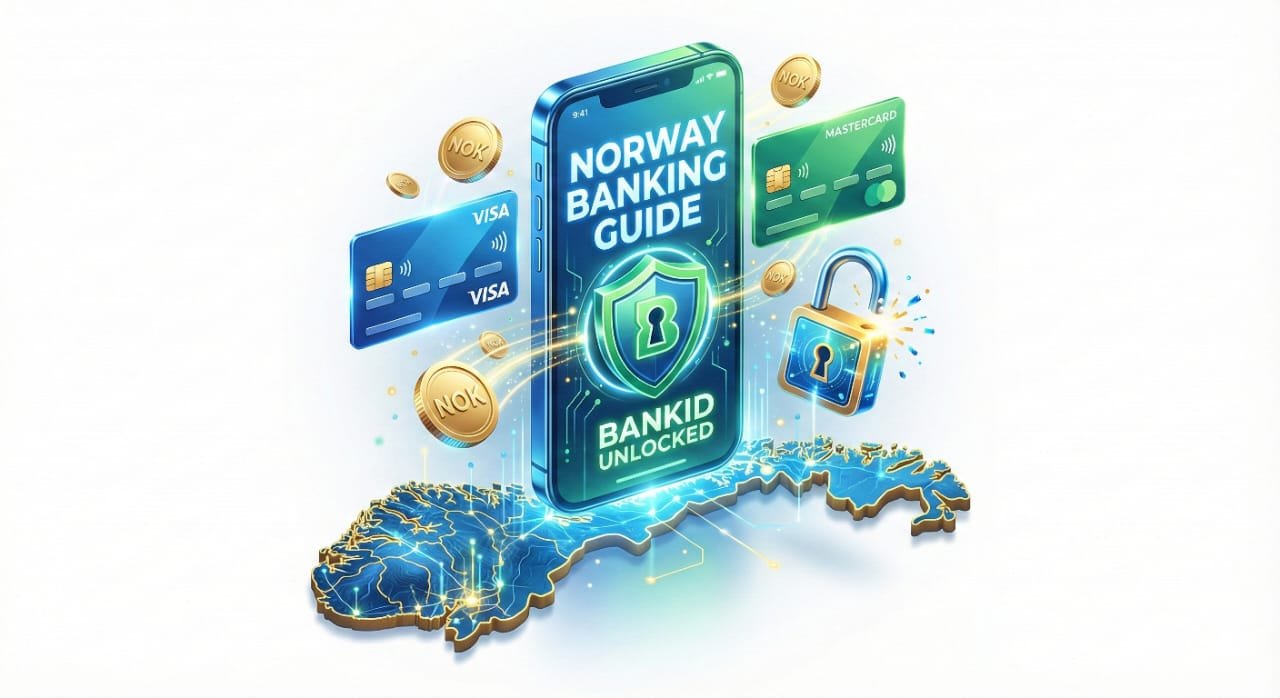
Picture this: You’ve just landed in Norway. The air is crisp, the fjords are breathtaking, and your excitement is at an all-time high. You walk into a cozy café in Oslo, order a latte, and reach into your pocket to pay with a crisp 200 kroner note. The barista smiles politely but shakes her head, pointing to a small sign: ‘No Cash.’
You try to pay for your bus ticket on board? Impossible. You try to set up a gym membership? They need a digital ID you don’t have yet.
Suddenly, that excitement turns into a cold knot of anxiety. You realize that without a plastic card or a digital app, you are effectively invisible in this economy.
Welcome to Norway in 2026. It is arguably the most efficient financial society on earth, but for a newcomer, it can feel less like a modern utopia and more like a fortress. With physical cash usage plummeting to record lows, being ‘unbanked’ here isn’t just inconvenient—it’s paralyzing.
Finding the right Bank in Norway is the first step to unlocking your life in this digital society. Back in 2025, we saw banking regulations tighten, and as we step into 2026, the digital walls remain high. You aren’t just missing out on easy payments; without a bank account, you are locked out of the digital ecosystem that governs everything from your tax card to your rental contract.
Table of Contents
ToggleThe Evolving Landscape of Bank in Norway in 2026
If you were researching Bank in Norway a few years ago, the advice you found then is likely obsolete today. The financial terrain has shifted dramatically leading into 2026, and understanding these changes is crucial before you even fill out an application form.
The most significant shockwave to hit the Bank in Norway market recently was the strategic exit…” of foreign retail banks and the major consolidation of the personal customer market. This move has fundamentally shifted how expats choose their primary Bank in Norway, replacing the remaining options with a landscape that feels much more exclusive. For years, digital challengers provided a solid, flexible alternative for foreigners. However, as we settle into 2026, those massive portfolios have been absorbed and transformed, effectively consolidating the sector into a stricter, compliance-heavy oligopoly.
What does this mean for you in 2026?
Simply put, there are fewer “traditional” doors to knock on. The competition has narrowed significantly, leaving us with a market dominated by three main pillars: the state-backed giant DNB, the pan-Nordic powerhouse Nordea, and the strong regional alliances of SpareBank 1.
This consolidation has a double-edged sword. On one hand, these remaining institutions are incredibly robust and offer world-class digital tools. On the other hand, the lack of fierce competition can make them slower to innovate on customer service for non-residents. They simply don’t need to fight for your business as aggressively as before, which is why the burden of proof is entirely on you to show you are a “safe” customer.
Furthermore, the divide between “Digital-only” tech banks and traditional banks has widened in 2026. You might be tempted by sleek, app-based banks like Sbanken (now fully integrated under DNB) or Bulder Bank. They look great on paper with their low fees and slick interfaces. But here is the catch that trips up almost every new arrival: you generally cannot open an account with them unless you already have BankID.
And you cannot get BankID without first opening an account at a physical bank that can scan your passport. It is a classic Catch-22 that we will need to strategically bypass. Navigating a Bank in Norway today requires more than just picking a brand you recognize; it requires understanding which of these financial fortresses has a drawbridge they are willing to lower for you.
Identity Requirements for Bank in Norway: D-Number vs. F-Number
If the banking landscape is the rough terrain you need to cross, your identity number is the vehicle you use to traverse it. And unfortunately, not all vehicles are built the same. Your success in opening an account with a Bank in Norway depends heavily on whether you hold a permanent ‘F-number’ or a temporary ‘D-number’.
When you register with the Norwegian authorities (Skatteetaten or SUA), you will be assigned one of two identification numbers. To you, it might just look like a string of eleven digits. To a bank, however, that number tells a vivid story about your stability, your risk level, and your future in the country. Understanding which number you have—and how banks perceive it—is the single most important factor in how fast your account will be opened.
The Two Tiers of Identity
F-Number (Gold Standard)
- Risk: Low
- Wait Time: 1-3 Days
- BankID: Instant Access
- Credit: Easy Approval
D-Number (Temporary)
- Risk: High
- Wait Time: 4-8 Weeks
- BankID: Manual/Strict
- Credit: Usually Denied
First, let’s clarify what you are holding.
1. The National Identity Number (Fødselsnummer): The “Gold Standard” This is the golden ticket. If you have this, the doors to almost every financial institution open wide.
Format: DDMMYY + 5 control digits. It looks like a birth date, but the power lies in those last digits.
The Vibe: Permanent. Stable. Low Risk. You are seen as a long-term resident who is here to stay.
The Banking Reality in 2026: If you have this number, you have effectively bypassed the biggest hurdles. You can often use automated onboarding systems found on bank websites without speaking to a human. If you already have a BankID (from another bank), you can apply for credit cards, loans, and easily secure a mortgage. The wait time is minimal—often just 1-2 days for full account activation.
2. The D-Number (D-nummer): The “Temporary” Flag This is a temporary identification number. It is typically given to foreign workers on short-term contracts (under 6 months), asylum seekers, or those waiting for their permanent residence application to process.
Format: It looks like a birth date, but the first digit is increased by 4. For example, if you were born on the 1st of the month, your D-Number starts with 41.
The Vibe: Temporary. Transient. “High Risk.”
The Banking Reality in 2026: Here is the hard truth regarding the Bank in Norway ecosystem for D-number holders: the waiting game hasn’t disappeared. While it is legally possible to open an account, most digital onboarding systems will automatically reject you. You are generally forced into a manual processing queue, which can take anywhere from 4 to 8 weeks depending on the bank’s backlog. Credit is usually denied, and BankID access is strictly limited until you prove extended residency.
Why the D-Number is a Red Flag
Here is the honest truth that most bank websites won’t tell you directly: Banks generally dislike D-numbers, and in 2026, their compliance software is tuned to flag them immediately.
It isn’t personal; it is regulatory. Under Norway’s strict Anti-Money Laundering (AML) laws, a customer with a D-number is flagged as “Higher Risk” by default. The logic is that you have no financial footprint in the country yet. From a risk management perspective, you are a transient customer who might leave at any moment, and verifying your background requires manual labor.
For a bank, a D-number applicant is an expensive administrative burden. A human compliance officer has to physically review your passport, cross-reference your employment contract, and manually approve your file. This is why you might hear stories of people with F-numbers getting accounts in 2 days, while their colleagues with D-numbers wait 6 weeks. You aren’t stuck in a bureaucratic backlog because of bad luck; you are stuck because your “vehicle” requires a manual inspection at every checkpoint.
See More Article
BankID: The Golden Key to Banks in Norway
If getting a bank account feels like a hurdle, getting BankID is the pole vault.
You might think you just want a bank account to receive your salary and buy groceries. But in reality, what you desperately need is BankID. It is impossible to overstate how critical this digital key is in 2026. It is not just a login tool for your online banking; it is your verified digital fingerprint for the entire Norwegian society.
Without BankID, you are living in 1995. With it, you are fully integrated into 2026.
What BankID Unlocks:
NAV: Accessing unemployment benefits, sick leave, or parental leave requires a BankID login.
Skatteetaten (Tax Administration): You need it to check your tax return and update your tax card. Without it, you are stuck mailing paper forms.
Helsenorge: This is the portal for your health. Want to change your GP, check a prescription, or see your vaccine records? You need BankID.
Vipps: The peer-to-peer payment app that everyone uses. You cannot activate Vipps without a BankID.
The "Catch-22" of the Norwegian System
This is the part of the movie where the protagonist realizes the game is rigged. There is a famous phrase that drives expats crazy, and you need to be prepared for it.
To get BankID, you generally need a Norwegian bank account and a National Identity Number.
To open a bank account easily online, the system asks you to log in with… BankID.
To get a National Identity Number, you need a residence permit and a police appointment, which can take months.
It is a perfect circle of frustration.
Furthermore, while banks are legally obligated to offer you a basic bank account (a simple debit card and an account number), they are not obligated to issue you a BankID. It is considered a separate “product” with higher security requirements.
This leads to a common nightmare scenario: A bank finally accepts your application and opens your account, but they refuse to issue you a BankID because you “only” have a D-number. They might give you a simplified login that works only for their specific banking app, leaving you locked out of NAV, Helsenorge, and Vipps.
How to Beat the Paradox (2026 Strategy)
To break this loop, you cannot rely on digital shortcuts. You have to go analog.
Do not apply online: If you have a D-number, the automated system will likely reject you.
Call the bank specifically: Ask for an appointment for “Passport Scanning and BankID issuance.”
Target specific banks: As mentioned earlier, Nordea and SpareBank 1 SR-Bank are historically more willing to issue BankID to D-number holders than the digital-only banks.
By understanding that the D-number is your primary bottleneck, you can stop fighting the automated systems that were built for locals and start navigating the manual channels designed for you.
Which Banks in Norway are Best for You in 2026?
Now that you understand the “Identity Number Game,” the field of competitors narrows significantly.
In a market that has just seen a major consolidation—goodbye, Danske Bank retail services—your choices effectively boil down to three main pillars: the state-backed giant, the Nordic powerhouse, and the regional alliances.
Choosing the wrong one in 2026 doesn’t just mean higher fees; it means weeks of extra waiting. Here is the unvarnished truth about the top contenders in 2026.
Onboarding & Monthly Fees for each Bank in Norway (Q1 2026 Data)
| Feature | DNB | Nordea | SpareBank 1 Sør-Norge (formerly SR-Bank) |
|---|---|---|---|
| Best For... | Long-term Expats / English Speakers | Tech-Savvy / Apple Pay Users | "Difficult" Cases / Human Support |
| D-Number Accepted? | Yes (Manual, Slow) | Yes (Manual) | Yes (Best Chance) |
| Setup Fee | Approx. 275 NOK (Card Fee) | 0 NOK | Approx. 300 - 395 NOK (Annual Card Fee) |
| Monthly Fee | 25 - 50 NOK (varies by program) | 25 NOK | Low / Free (Pay yearly for card) |
| Apple Pay? | No (Only via Sbanken concept) | Yes (Native) | Yes |
| English App? | Excellent (Native) | Good | Mixed (Some parts Norwegian) |
1. DNB (Den Norske Bank): The State-Backed Behemoth
The Vibe: Corporate. Secure. Slow.
DNB is the 800-pound gorilla of the Norwegian banking sector. If you are looking for a reliable and robust Bank in Norway backed by the state, DNB is often the first name that comes up. It holds the largest share of the market and is the default bank for major corporations. Because of this, most foreign employers instinctively apply here first.
The Pros:
English Interface: DNB has the most comprehensive English-language website and online banking interface in 2026. You generally won’t need Google Translate to pay your bills.
Global Reach: If you need to wire large sums internationally, their infrastructure is rock solid.
The Cons:
The “Foreigner Fee”: Here is the detail that stings a bit. DNB charges a specific onboarding fee for non-EU citizens (usually around 2,500 NOK for manual processing). It feels unfair to pay this before you’ve even earned your first krone, but honestly? It is the price of admission. Since they are one of the few banks that will actually process your application without a BankID, just swallow the pill and pay it. It buys you stability.
Bureaucratic Pace: Because they are the biggest, they are also the busiest. Reports from late 2025 confirm that manual applications for D-numbers can consistently take 6-8 weeks.
No Native Apple Pay: In 2026, DNB still pushes its own agenda. While they own Sbanken (which has Apple Pay), the core DNB cards generally do not support Apple Pay directly, forcing you to use their specific solutions.
2. Nordea: The Nordic All-Rounder
The Vibe: Modern. Efficient. Tech-Savvy.
Following their acquisition of Danske Bank’s personal customers, Nordea has cemented itself as the best “all-rounder” for expats. Many foreigners consider Nordea to be the most technologically advanced Bank in Norway for daily needs They are used to cross-border clients (operating in Sweden, Denmark, and Finland) and have better processes for handling non-citizens.
The Pros:
Apple Pay Support: Unlike DNB, Nordea fully embraces digital wallets like Apple Pay and Google Pay. If you live on your phone, this is a dealbreaker.
The “Monthly Subscription” Model: Their pricing is transparent. For around 25 NOK per month, you get a debit card and an online banking subscription. No hidden annual shocks; just a small monthly fee.
The Cons:
D-Number Friendliness: They are generally good, but strictly “by the book.” If your employment contract has any irregularities, their automated risk filter will block you faster than DNB’s humans will.
3. Spare Bank 1 Alliance (SR-Bank & SMN): The Insider Tip
The Vibe: Local. Personal. Flexible.
Important 2026 Update: You might know them as “SR-Bank,” but following the massive merger in 2024-25, the southern giant is now SpareBank 1 Sør-Norge.
SpareBank 1 isn’t just one Bank in Norway; it’s a network of regional alliances. The standout for expats is SpareBank 1 Sør-Norge (Stavanger/South) and SpareBank 1 SMN (Trondheim).
The Pros:
Human Discretion: Because decisions are often made at the branch level rather than a centralized HQ in Oslo, branch managers have more autonomy.
Best for D-Numbers: If you are rejected by DNB’s robots, walking into a SpareBank 1 branch is your best “Plan B.” They are historically more willing to manually verify a passport and issue a BankID to a D-number holder than the digital giants.
Fees: They typically charge an annual fee (approx. 300-395 NOK) for the Visa card rather than a monthly subscription.
Verdict: If you live in their region (West Coast or Central Norway), this is often your best bet for a fast account opening.
Digital Alternatives and Fintech Banks in Norway
While you wait for a major Bank in Norway to process your paperwork, you need a Plan B. You cannot survive in 2026 with just cash.
If traditional banks are the fortress, these digital alternatives are the tents you pitch outside the walls. They won’t get you inside the castle (BankID), but they will keep you warm (allow you to pay for food and transport).
1. Lunar (The Nordic Challenger) Lunar is a Danish fintech bank that operates fully in Norway.
The Good: They are a real bank with a Norwegian account number. You can use this to receive your salary in NOK without currency conversion fees. Their app is beautiful and 100% English.
The Bad: In 2026, their onboarding for non-citizens has become stricter. They sometimes require a physical passport scan or extra documentation, but they are generally faster than DNB.
The Catch: No BankID: This is the heartbreaking part. Lunar is amazing, but they legally cannot issue your first BankID because they don’t have physical branches to scan your passport. So, you cannot start here. Think of Lunar as your “second step”—open a DNB or SpareBank 1 account first just to get the BankID, and then switch to Lunar later to save money.
2. Wise (Formerly TransferWise)
The Good: Essential for the first month. You can get a Norwegian account number (via their multi-currency account) to receive salary. The exchange rates are unbeatable.
The Bad: It is not a “Bank” in the legal Norwegian sense for BankID purposes. It is a payment institution.
3. Revolut
The Good: Great for daily spending and splitting bills.
The Bad: Norwegian employers often dislike paying salaries into Revolut accounts due to IBAN discrimination (though illegal, it happens). Like the others, it offers zero path to BankID.
“Not yet” Bank: Banken and Bulder
You will hear Norwegians rave about Sbanken (owned by DNB) and Bulder (owned by SpareBank 1 Vest) because of their low mortgage rates and slick apps.
The Reality for You: Ignore them for now. Both are digital-only concepts that require an existing BankID to become a customer. They have no physical branches to scan your passport, so they legally cannot onboard you as your first Bank in Norway.
Strategy: Wait until you have secured BankID from a traditional bank, then switch to Sbanken or Bulder later to save money on fees.
The Step-by-Step Battle Plan to Open an Account with Banks in Norway
You don’t walk into a Bank in Norway and expect to leave with a debit card. You need to treat this process like a legal defense case. Norwegian compliance officers are strict, so your preparation must be undeniable.
The "Documentation Pack"
Before you even book an appointment, ensure you have a physical folder containing the following originals.
The Passport (Critical): It must be a valid passport, as almost every Bank in Norway rejects National ID cards for BankID issuance. because they lack the specific biometric data banks require.
Proof of ID Number: The official letter from Skatteetaten (Tax Administration) confirming your D-number or F-number.
Employment Contract: It must be signed by both parties and dated within the last 3 months. If you are a student, bring your Letter of Admission.
Proof of Address: A rental contract or a printout from the National Registry (Folkeregisteret).
TIN (Tax Identification Number): This is the one most expats forget. Due to CRS (Common Reporting Standard) and FATCA (for US citizens), the bank must know your tax residence number in your home country. If you don’t have this number ready, the meeting will end immediately.
The “Mailbox rules”
This sounds trivial, but in 2026 it still causes 50% of all delays.
Norwegian Post (Posten) is incredibly strict. If your name is not clearly printed on your physical mailbox, they will return your debit card and code token to the bank immediately. They will not call you; they will just send it back.
Action: Put a label with your full name on your door/mailbox the day you move in.
Vipps: The Reason You Need Bank in Norway
You might think you can survive with just a debit card, but in Norway, social life runs on a specific app.
Vipps: The Social Currency Vipps is the peer-to-peer payment app that everyone uses. From splitting a dinner bill to buying a waffle at a school fundraiser, “Vippsing” is a verb here. To activate a full Vipps profile, you need the “Holy Trinity” of Norwegian Bureaucracy:
A Norwegian Bank Account Number.
A Norwegian Debit Card.
BankID.
Here is the kicker: While Vipps has technically loosened rules to allow some limited access with D-numbers, the reality for 2026 is that you generally need BankID to sign the user agreements and fully authenticate the card.
If your Bank in Norway gives you a “light” login without BankID, you are effectively locked out of the Vipps ecosystem. This leaves you socially isolated when the bill comes at a restaurant and everyone else pulls out their phones while you awkwardly fumble for cash that the restaurant might not even accept.
The 3-Month Strategic Roadmap
Month 1: Survival
Open Lunar, get D-Number, and label your mailbox.
Month 2: Waiting
Attend bank appointment and undergo manual vetting.
Month 3: Integration
Receive Code Token, activate BankID, and set up Vipps.
Following this 3-month timeline will ensure you successfully secure your account without losing your mind.
Month 1: Survival
Day 1: Register with the Police/SUA to trigger your D-number application. Do not wait.
Week 1: Put your name on your mailbox. If you don’t, your official letters will bounce back.
Week 2-3: Receive your D-number letter. Immediately call Nordea or SpareBank 1 to book a “Passport Scanning Appointment.” Do not apply online.
Month 2: The “Waiting” Phase
Week 4-8: Wait. The bank is manually writing you into their system. If they look for more info, reply within 2 hours to keep your file moving.
Month 3: Integration
Week 9: Receive Code Token (Kodebrikke) and Debit Card in the mail.
Week 10: Log in and activate your BankID.
Week 11: Download Vipps, connect your new card, and buy your first pølse (hot dog) like a local.
Week 12 (Optional): Now that you have BankID, you can apply to Sbanken or Bulder to save money on fees if you prefer.
Conclusion
Navigating a Bank in Norway in 2026 is a system designed for trust, security, and total digitization. For the insider, it is a seamless dream. For the outsider, it is a fortress with high walls.
The exit of major foreign banks and recent market consolidations have narrowed your options, but they have also clarified them. You now know that Nordea and SpareBank 1 are your primary targets, that the D-number is your biggest obstacle, and that BankID is the prize you are actually fighting for.
It will be frustrating. You will likely be rejected by an automated system at least once. But armed with this guide, you aren’t just another “high-risk” applicant; you are a prepared strategist. Get your documentation ready, label your mailbox, and be patient. The fortress will open.
People Also Ask
Best bank in Norway for foreigners?
How to get a bank account in Norway?
Biggest bank in Norway?
Norway bank holidays (2026)
- New Year's Day: Jan 1
- Maundy Thursday: April 2
- Good Friday: April 3
- Easter Monday: April 6
- Labour Day: May 1
- Constitution Day: May 17
- Ascension Day: May 14
- Whit Monday: May 25
- Christmas: Dec 25-26