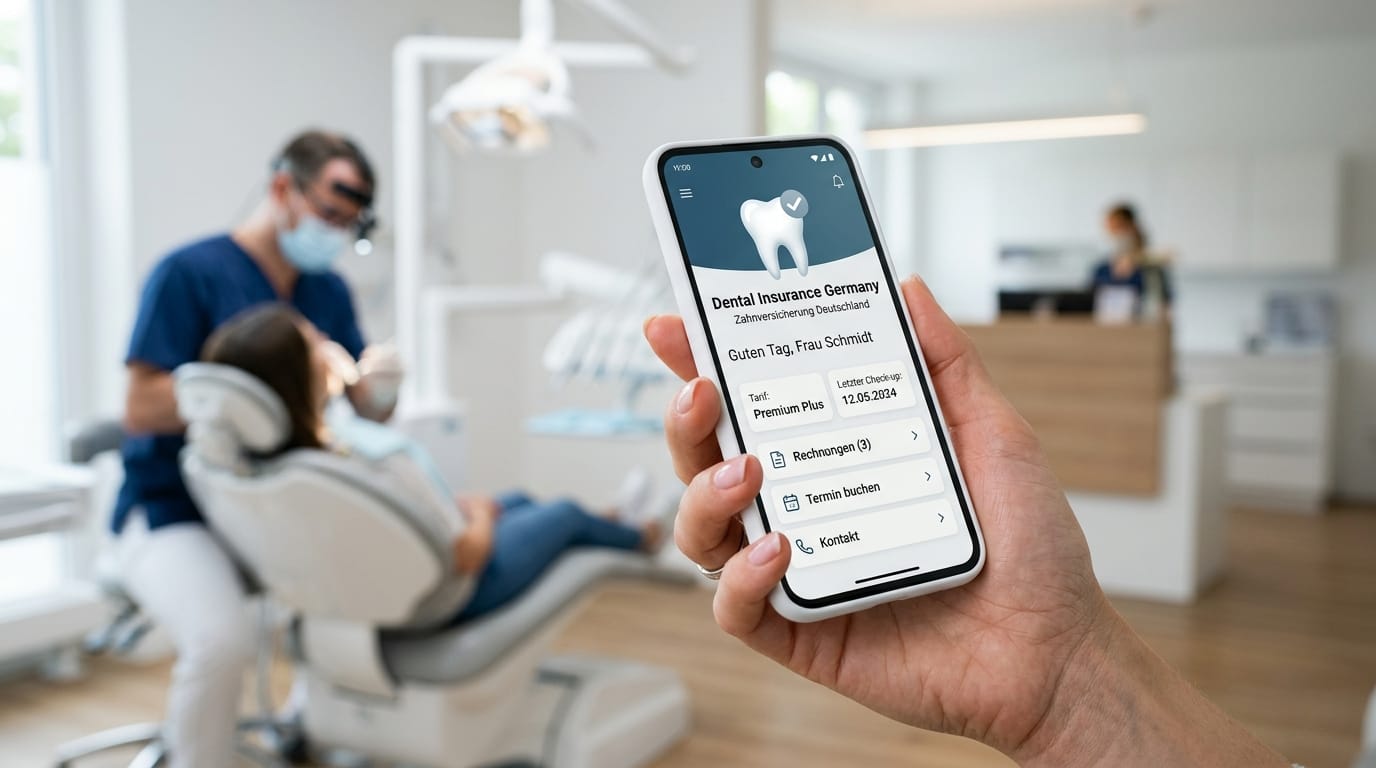

Let’s skip the dramatic stories and get straight to the reality of the German healthcare system: your public health insurance covers the bare minimum when it comes to your teeth. If you want a modern tooth-colored filling, a professional cleaning, or a ceramic crown, you are going to pay for it almost entirely out of pocket.
Figuring out dental insurance in Germany is a required step for any expat who wants to protect their savings from massive, unexpected dentist bills. The system is split, the rules are rigid, and the German paperwork can be overwhelming if you don’t know what you are looking for.
In this 2026 guide, we are cutting through the confusing bureaucracy. I’ll give you a clear, no-nonsense breakdown of the actual out-of-pocket costs, the hidden policy traps you need to dodge, and a straight-to-the-point comparison of the top English-speaking providers. Let’s get into it.
If you are in a rush and just want to know where to put your money, here are the top 3 expat-friendly provider recommendations for 2026 based on our deep-dive analysis:
- Feather
The absolute best for customer service. They offer an entirely English-speaking experience, stellar support (4.8 on Trustpilot), and act as an incredibly helpful middleman. Great if you hate German bureaucracy.
- Getsafe
The best for young, budget-conscious expats with healthy teeth. Starts at just €9.31/month. Covers cleanings and basic work brilliantly, but you’ll pay a 25% co-pay if you ever need a massive implant.
- Ottonova
The premium, all-digital choice for high earners. Flawless English app, covers top-tier luxury dental billing, but comes with a higher monthly price tag and stricter claim checks.
Table of Contents
Toggle1. The Public Health Trap: Why You Actually Need Dental Insurance in Germany
To understand why over 17.8 million residents here pay out of pocket for supplemental dental care, you need to understand what your baseline public health insurance actually does.
If you are with a major public fund like Techniker Krankenkasse (TK), AOK, or Barmer, your coverage is legally restricted by a principle called standard, baseline care.
The Bare-Minimum Approach (Regelversorgung)
Imagine your car breaks down. The public health system is legally obligated to get your car running again safely, but they are absolutely not going to pay for a nice paint job, leather seats, or a modern stereo. They will use the cheapest, most basic parts available.
In German, this is called Regelversorgung (Standard Care). The public system covers what is strictly medically necessary, economical, and functional. It explicitly ignores aesthetics and advanced preventative medicine.
For example, dentists worldwide agree that an annual professional teeth cleaning is crucial to stop decay. But under this “standard care” rule, full professional cleanings are excluded. The system only pays to scrape off basic tartar. Some forward-thinking funds like TK might throw you a tiny €40 bone once a year, but you are paying the rest.
If you need a crown or a bridge, the public system does not pay a percentage of your dentist’s actual invoice. Instead, they use a fixed subsidy system called the Festzuschuss. They look up the absolute cheapest, ugliest, base-metal solution for your specific tooth problem, and they give you a lump sum covering 60% of that cheap option.
In 2026, the baseline prices for these cheap laboratory metals (the BEL II prices) went up by 4.78%. But here is the catch: if you want a modern, tooth-colored ceramic crown so you don’t look like a pirate when you smile, the public system still only gives you the tiny lump sum meant for the cheap metal one. You have to pay the massive price differential out of your own pocket. If you are still trying to wrap your head around how your baseline coverage actually works, I highly recommend taking a quick look at our complete guide to health insurance in Germany.
The Little Booklet (Bonusheft) and Hardship Rules
The public system tries to bribe you to go to the dentist every year with a little physical book called a Bonusheft.
If you get your teeth checked every single year and get your book stamped, your 60% subsidy for those cheap, base-metal treatments goes up. After five consecutive years, it hits 70%. After ten years, it maxes out at 75%. But honestly? Because this percentage only applies to the cheapest possible treatment, ten years of perfect attendance barely makes a dent if you want a premium ceramic implant.
There is a safety net for people in deep financial trouble, called the Härtefallregelung (Hardship Clause). If you earn less than €1,316 gross per month (the 2026 limit for a single person), the public system pays 100% of the cost for standard care. But for 99% of working expats, you earn too much to qualify, leaving you completely exposed.
2. Real Cost Breakdown: Your Out-of-Pocket Reality in 2026
Let’s look at the actual numbers. Because of dental inflation and the cost of modern materials, relying purely on the public system is financially dangerous.
Here is what it actually costs when you sit in the chair without private supplemental coverage:
| Dental Procedure | Typical Total Cost | What Public Insurance Does | Your Out-of-Pocket Cost |
|---|---|---|---|
| Professional Teeth Cleaning (PZR) | €80 – €120 | Basic tartar removal only. (Possible €40 subsidy). | €80 – €120 |
| Composite Fillings (White) | €80 – €250 | Covers dark metal amalgam only. | €30 – €200 |
| Periodontal Treatment | €150 – €600 | Covers basic cleaning; excludes modern laser therapy. | €150 – €600 |
| Root Canal | €600 – €1,000+ | Strict criteria. Excludes microscope work. | €600 – €1,000+ |
| Ceramic Crown | €1,000 – €1,500 | Fixed subsidy for cheap metal (approx. €200). | €800 – €1,200 |
| Ceramic Bridge | €1,500 – €2,500 | Fixed subsidy for metal bridge (approx. €460). | €1,000 – €2,000 |
| Dental Implant | €2,000 – €3,000+ | Titanium screw 100% excluded. Only tiny crown subsidy. | €1,500 – €2,500 |
Imagine this scenario: You bite down on a hard pretzel, crack a molar, need a complex root canal, and eventually require a single implant to replace it. Your dentist hands you a bill for €3,500. Without a supplemental policy, almost all of that is coming straight out of your checking account.
3. The Hidden Rules & Fine Print: Understanding Dental Insurance in Germany
You can’t just buy insurance on your phone while sitting in the dentist’s waiting room. Insurance companies exist to pool risk, and they have strict traps set up to stop people from only buying a policy when they know they need a €3,000 tooth replacement.
The Probationary Timeout (Wartezeit) & Pre-Existing Conditions
Historically, German insurers used a probationary lock-out period called a Wartezeit. You had to pay premiums for three months before getting a filling, and wait a brutal eight months before claiming a crown or an implant.
Good news: The modern 2026 digital startups (like Feather, Getsafe, and Ottonova) have killed the waiting period. You can sign up today and go get your teeth cleaned tomorrow.
But here is the massive trap: Zero waiting time does not mean they cover pre-existing, known problems.
If your dentist looked in your mouth last week, verbally said, “You need a crown here soon,” or wrote it down in your patient file, that tooth is a pre-existing condition. The insurer will check your files. If the problem was diagnosed before your contract started, they will deny the claim 100% of the time. Insurance is for future surprises, not fixing a burning house you already own.
The Payout Speed Limit (Zahnstaffel)
To stop people from buying a policy, claiming €10,000 in implants, and immediately canceling, insurers use a reimbursement speed limit.
In German, this is the Zahnstaffel. It means that even if you buy a “100% Coverage” policy, your actual payout is capped inside a financial bucket that slowly gets bigger over the first 4 to 5 years.
Once you survive this scaling period, coverage becomes unlimited. (Note: These limits are usually waived if you smash your teeth in a random accident after buying the policy).
Let’s look at the 2026 limits for major providers. This is the maximum cumulative amount they will pay out over your first few years:
- Getsafe Dental: Year 1 max: €1,500 | Year 2 max: €3,000 | Year 3 max: €4,500 | Unlimited starting Year 4.
Barmenia Mehr Zahn 100: Year 1 max: €1,500 | Year 2 max: €3,000 | Year 3 max: €4,500 | Year 4 max: €6,000 | Unlimited starting Year 5.
Ottonova Zahn 100+: Year 1 max: €1,250 | Year 2 max: €2,500 | Year 3 max: €3,750 | Year 4 max: €5,000 | Unlimited starting Year 5.
DFV Exklusiv 100: Year 1 max: €1,750 | Year 2 max: €3,500 | Year 3 max: €5,250 | Year 4 max: €7,000 | Unlimited starting Year 5.
If you need €6,000 worth of implants in Year 2 with Barmenia, they will only give you €3,000. You pay the rest. The “100%” promise only applies within the limits of this bucket.
What if I already have missing teeth?
If you already have a tooth missing (that hasn’t been permanently replaced), you are a walking liability to the insurer.
Getsafe: Zero tolerance. If you have a missing tooth when you sign up, it is forever excluded.
Barmenia: Very forgiving. They usually let you insure one missing tooth without punishing you. But if you are missing 2 or 3 teeth, they will aggressively shrink your Zahnstaffel limits.
The Surge Pricing Trap (GOZ Steigerungsfaktor)
German private dentists bill using a legal menu called the GOZ. Every procedure has a base price. Depending on how hard the surgery is, the dentist multiplies that base price by a “severity factor.” Think of it like Uber surge pricing.
2.3x Multiplier: A totally normal, average difficulty treatment.
3.5x Multiplier: A very complex treatment. This is the legal maximum they can charge normally.
5.0x Multiplier (or higher): Elite, super-specialized luxury treatment. They have to make you sign a special contract before doing this.
Budget insurance policies only cover up to the 3.5x multiplier. If you unknowingly walk into a fancy Berlin clinic that charges the 5.0x rate for an implant, you have to pay the massive difference yourself. Premium plans (like Ottonova’s top tier) specifically cover these 5.0x luxury bills.
4. Provider Deep-Dive: Comparing the Best Dental Insurance in Germany
Okay, let’s talk about where to actually put your money. The market in 2026 is a war between old-school German giants and sleek English-speaking tech startups. Here is the brutally honest breakdown.
1. Ottonova
Ottonova is a fully digital, licensed insurer built for high-earning expats. They offer three tiers: Economy (70%), Business (85% to 90%), and First Class (100%).
The Good: Their app and customer support are flawlessly natively English. Claiming money back is as easy as taking a photo on your phone, and they pay out in days. Their First Class tier protects you against those crazy 5.0x luxury dentist bills.
The Catch: It’s expensive, starting around €15.42/month for young healthy folks and climbing fast as you age. Their Zahnstaffel is a bit stingy in year one (€1,250 cap). Also, recent reviews show their Trustpilot scores slipping a bit because they strictly audit big claims to protect their profits.
2. Feather
Feather isn’t technically an insurance carrier; they are a brilliant middleman (an MGA) that repackages policies from massive giants like Barmenia into beautifully simple, expat-friendly products. They offer Basic (from €10.90) and Advanced (from €28.55).
The Good: Customer service is legendary (4.8 Trustpilot). If a German hospital sends you a terrifying 12-page letter, Feather’s English support team will translate it and fight the bureaucracy for you. The Advanced plan offers unlimited teeth cleanings and gives you a sweet €200 allowance for cosmetic bleaching every two years.
The Catch: Because they are a middleman, recent market inflation forced them to hike prices. The Advanced plan is now quite pricey. But if German bureaucracy gives you anxiety, the premium is worth every penny.
3. Getsafe
Getsafe targets young expats who want cheap, app-based coverage. They offer a unified base plan starting at just €9.31 per month, with add-ons available.
The Good: Unbeatable price and speed. They cover basic root canals and fillings perfectly. They have the best Zahnstaffel on the market—all limits disappear completely after year three. They also give you €200 for cosmetic bleaching every two years on premium plans.
The Catch: To keep prices low, Getsafe forces a massive compromise: they cap expensive implants and dentures at 75%. If you need a €4,000 implant, you must co-pay 25% (€1,000). They also completely exclude adult braces (orthodontics).
4. Barmenia (Mehr Zahn 100)
Barmenia is a massive, traditional German titan. They constantly win consumer awards (Stiftung Warentest) for having the mathematically strongest policy.
The Good: Bulletproof coverage. True 100% payouts on massive surgeries. A gigantic €6,000 Zahnstaffel limit by year four. They are even cool with insuring one missing tooth. If you want absolute financial security, this is it.
The Catch: It is painfully German. Their app is in German. Their letters are in German. Expats constantly complain about the language barrier when claims get complicated, leading to an abysmal 1.6 Trustpilot score. Choose them only if you speak B1/B2 German or have a patient German partner to help you.
5. Specific Coverages: Cleanings, Braces, and Sleeping Through Surgery
When choosing your supplemental dental care plan, the headline “100% coverage” doesn’t tell the whole story. You need to look at the daily stuff.
Teeth Cleaning Allowances (PZR)
Insurance companies know you will use this every year, so they cap it tightly to save money.
Getsafe: €80/year standard. (Unlimited if you buy the Premium Plus add-on).
Feather: €150/year on Basic. Unlimited on Advanced.
Ottonova: €70/year on Economy. Up to €180/year on First Class.
Barmenia: 100% coverage, but capped at €200 maximum per year.
Orthodontics & Braces (The KIG Scale)
German dental rules use a strict ruler called the KIG scale to measure how crooked teeth are, from KIG 1 (mildly annoying) to KIG 5 (severe medical dysfunction).
For kids, the public system pays for KIG 3, 4, and 5 (you pay 20% upfront and get it back later). But the public system pays zero for KIG 1 and 2. High-end private plans cover this gap for children, offering thousands of euros to fix minor crowding.
But what about adults? The public system will not pay for adult braces unless you were in a horrific jaw-smashing accident. Private plans are just as mean. Getsafe completely excludes adult orthodontics. Ottonova and Barmenia will allow it (up to €5,000), but strictly only if it’s a dire medical necessity. They will absolutely not pay for your cosmetic Invisalign to make your smile look better for Instagram.
Anesthesia and Pain Relief
Public insurance covers a basic novocaine needle. But if you have dental anxiety and want nitrous oxide (laughing gas, €125-€175) or a full sleep IV drip (€250-€350), you are paying out of pocket. If this matters to you, get Getsafe, Feather Advanced, or Barmenia—they cover these luxury pain reliefs at 100%.
(Side note: Purely cosmetic stuff like veneers for healthy teeth are excluded by everyone. The only cosmetic thing insurers occasionally pay for is tooth bleaching, usually up to €200 every two years).
6. Bureaucracy & Claims: Surviving the Paperwork
German paperwork is a sport. If you don’t play by the rules, you lose your money.
The Architect's Blueprint (Heil- und Kostenplan)
If you need major work (like an implant), your dentist cannot just start drilling. By law, they must draft a massive, highly detailed blueprint and cost estimate called a Heil- und Kostenplan (HKP).
Here is the absolute golden rule:
Your dentist gives you the HKP.
You send it to your public insurer (TK, AOK) to get their physical stamp. (Takes 1-3 weeks).
You upload that stamped paper to your private app (Feather, Ottonova, etc.) to get their guarantee.
DO NOT let the dentist touch your teeth until BOTH insurers have approved it. If you start treatment early, your private insurer will void the contract and pay you nothing.
Claims and Canceling
For normal stuff like cleanings or simple fillings, you don’t need the big blueprint. You pay the dentist directly via bank transfer, snap a photo of the invoice in your app, and digital providers like Getsafe and Ottonova will wire you the money back in 2 to 14 days.
What if you leave Germany? Getsafe and Barmenia lock you in for 12 months, then let you cancel monthly. Ottonova and Feather lock you in for 24 months. However, Feather has a brilliant expat escape hatch: if you officially deregister from Germany (getting your Abmeldung from the Bürgeramt) and leave the country, Feather will immediately cancel your contract and free you, regardless of the 24-month rule.
7. The Great Tax Myth: Can I Deduct My Bills?
A lot of expats think, “I won’t buy insurance; if I get a massive €5,000 dental bill, I’ll just write it off when filing my tax return in Germany. Let me be brutally honest: this is a terrible financial strategy.
The Deduction Cap
Yes, private dental premiums are technically classed as “other precautionary expenses” (sonstige Vorsorgeaufwendungen). The tax office allows single employees to deduct up to €1,900 per year (freelancers get €2,800; married couples get €3,800/€5,600).
But here is the reality check: the mandatory health insurance (GKV) and nursing care tax that is automatically pulled from your monthly paycheck almost always exceeds that €1,900 limit immediately. Because your basic health insurance eats up the entire allowance, there is no room left to deduct your supplemental dental premiums.
(The only people who can actually use this tax deduction are university students on cheap tariffs, spouses who don’t work and are on family insurance, or civil servants).
The Pain Threshold (Zumutbare Belastung)
Okay, but what if you don’t buy insurance, get a massive bill, and try to deduct the raw medical costs as an “extraordinary financial burden”?
The German government uses a nasty formula called the “Reasonable Burden” (Zumutbare Belastung). They legally decide that based on your income, you should be in a certain amount of financial pain before they help you.
Let’s run a real 2026 calculation: Imagine you are a single expat earning €65,000 gross. You have a catastrophic tooth failure and get a €4,500 bill for implants. You try to write it off. The tax office calculates your “Reasonable Burden” progressively:
Tier 1: They take 5% of your income up to €15,340 = €767.00.
Tier 2: They take 6% of your income between €15,341 and €51,130 = €2,147.40.
Tier 3: They take 7% of your remaining income above €51,130 = €970.90.
Total “Reasonable Burden”: €3,885.30.
The government decrees that you are financially healthy enough to absorb €3,885.30 of medical pain. Therefore, out of your devastating €4,500 bill, you can only deduct a miserable €614.70.
Relying on German tax deductions to save you from dental failure is a complete illusion. You have to transfer the risk upfront.
My Final Advice
Living in Germany is wonderful, but protecting yourself financially is an absolute must. Just like setting up your liability insurance in Germany, getting a solid dental policy is one of the smartest investments you can make to protect your savings. When it comes to your teeth, the gap between what you want and what the state provides is thousands of euros wide.
Do not wait until your tooth hurts to start researching dental insurance in Germany. Because of strict exclusions on pre-existing conditions and the slow-releasing Zahnstaffel buckets, you must buy coverage before the architect needs to draw up a blueprint for your mouth.
Pick Feather if you hate paperwork, Getsafe if you are young and want cheap basics, or Ottonova/Barmenia if you want heavy-duty, premium protection. Lock it in, go get your free teeth cleaning, and enjoy the peace of mind.
Frequently Asked Questions
I chipped my tooth yesterday. Can I buy a "zero-waiting-period" insurance today?
No. This is the single biggest trap expats fall into. While providers like Getsafe or Feather have "no waiting periods" (meaning you can get a teeth cleaning immediately), they strictly exclude pre-existing conditions. If the tooth is already broken, or if your dentist has already looked at it and said "you need a crown," that specific tooth is uninsurable for that specific problem. Insurance covers the future, not the past.
My dentist is asking me to sign a "private fee agreement". Is this a scam?
It’s not a scam, but it is a warning sign for your wallet. German dentists use a standard billing multiplier. However, for highly specialized work they are legally allowed to charge you a massive luxury multiplier (e.g., 5.0x). To do this legally, they must make you sign a private agreement first. Most budget plans will not cover anything above 3.5x. If you sign it, you are personally on the hook for the difference.
I grind my teeth at night. Will insurance cover a night guard (Beißschiene)?
Good news here! If a dentist diagnoses you with bruxism (teeth grinding), the public health insurance (TK, AOK, etc.) will actually cover 100% of the cost for a standard, basic hard-plastic night guard. However, if you want a premium, high-tech flexible guard, public won't cover it, and you'll need to check your private supplemental policy's specific rules.
Will any German insurance pay for adult Invisalign?
Let me save you hours of research: No. The public system completely refuses adult orthodontics unless you were in a horrific jaw-crushing accident. Private supplemental insurers are just as strict. Even premium policies explicitly state it must be a severe medical necessity. No German insurer is going to subsidize your cosmetic Invisalign.
My dentist says I must pay for a €120 cleaning before they treat cavities. Can they?
Some premium or boutique clinics in major cities have strict policies requiring a clean mouth before restorative work. While legally they can't deny emergency pain relief, they can refuse you as a non-emergency patient if you don't agree to their treatment plan. Having a basic supplemental plan (which covers the PZR) removes this €120 friction entirely.
Am I legally trapped in a 24-month contract if I leave Germany?
It depends. Ottonova enforces the 2-year lock-in. Barmenia and Getsafe let you cancel monthly after the first 12 months. However, Feather has a specific "Expat Escape Clause." If you officially deregister your address in Germany (getting your Abmeldung) and leave the country, Feather will immediately cancel your contract, completely ignoring the 24-month rule.