Picture this. You just moved to Germany. You are exhausted from unpacking boxes, navigating the subway system, and trying to remember if “Ausfahrt” is a destination or just an exit sign.
You wander into a cozy, amazing-smelling bakery in Berlin. You order a warm pretzel and a coffee. The total is €4.50.
You smile, pull out your shiny, premium Visa card from your home country, and hand it to the cashier.
The cashier stares at the card. Then they stare at you.
“Nur Bar oder EC-Karte!” they say, pointing aggressively to a small, faded sticker on the register. Cash or EC card only.
You freeze. You check your pockets. No cash. The line of ten hungry locals behind you lets out a collective, impatient sigh. You awkwardly apologize, leave your coffee on the counter, and walk out feeling totally defeated.
Welcome to Germany.
If this exact scenario has happened to you, grab a coffee, pull up a chair, and take a deep breath. I know exactly how you feel. As an expat who has lived here for years—and the lead financial writer for FinArmour—I have been the person holding up the bakery line. I have been the person rejected by a local bank for no logical reason.
The German banking system is confusing, frustrating, and heavily reliant on paper and physical cash. But you are not alone, and it is entirely possible to navigate it.
Today, we are going to sit down and walk through everything you need to know about getting a credit card in Germany. We will look at brand new data from 2026, figure out how to beat the dreaded credit algorithms, and find the absolute best card for your wallet so you never have to leave a pretzel behind again.
Table of Contents
ToggleWhy Does Germany Hate Plastic? (The Psychology of Cash)
To survive the banking system here, you first need to understand why things are the way they are.
Germany’s obsession with physical cash isn’t just a quirky habit. It is a deep, generational trauma. Back in 1923, during the Weimar Republic, the country experienced catastrophic hyperinflation. Money lost its value so fast that people were bringing wheelbarrows full of cash just to buy a loaf of bread. The exchange rate hit 130 billion Marks for a single US dollar.
Then came the economic wipeout following the Second World War.
Because of this history, the German mindset became fiercely protective of money. People here value extreme frugality. They love physical cash because they can see it, control it, and keep their purchases totally private.
Here is a wild fact: The German word for debt is Schulden. This word comes from the root word Schuld.
Do you know what Schuld translates to in English?
Guilt.
In Germany, having debt literally means having guilt. That linguistic connection completely drives their financial culture. People here hate living beyond their means.
But things are finally shifting. In 2023, the market hit a massive tipping point. For the very first time in history, debit card spending (32%) officially overtook physical cash spending (26%). Today, in-person cash transactions have dropped to about 51%.
German Payment Methods (2023 Data)
Debit cards have officially overtaken cash for the first time in German history.
Things are getting more digital, but the cultural fear of going into debt is still the biggest factor determining what kind of cards the banks will offer you.
The Big Mix-Up: EC-Karte vs. Real Credit Cards
The number one point of friction for international students and expats is the massive confusion over what a “card” actually is here.
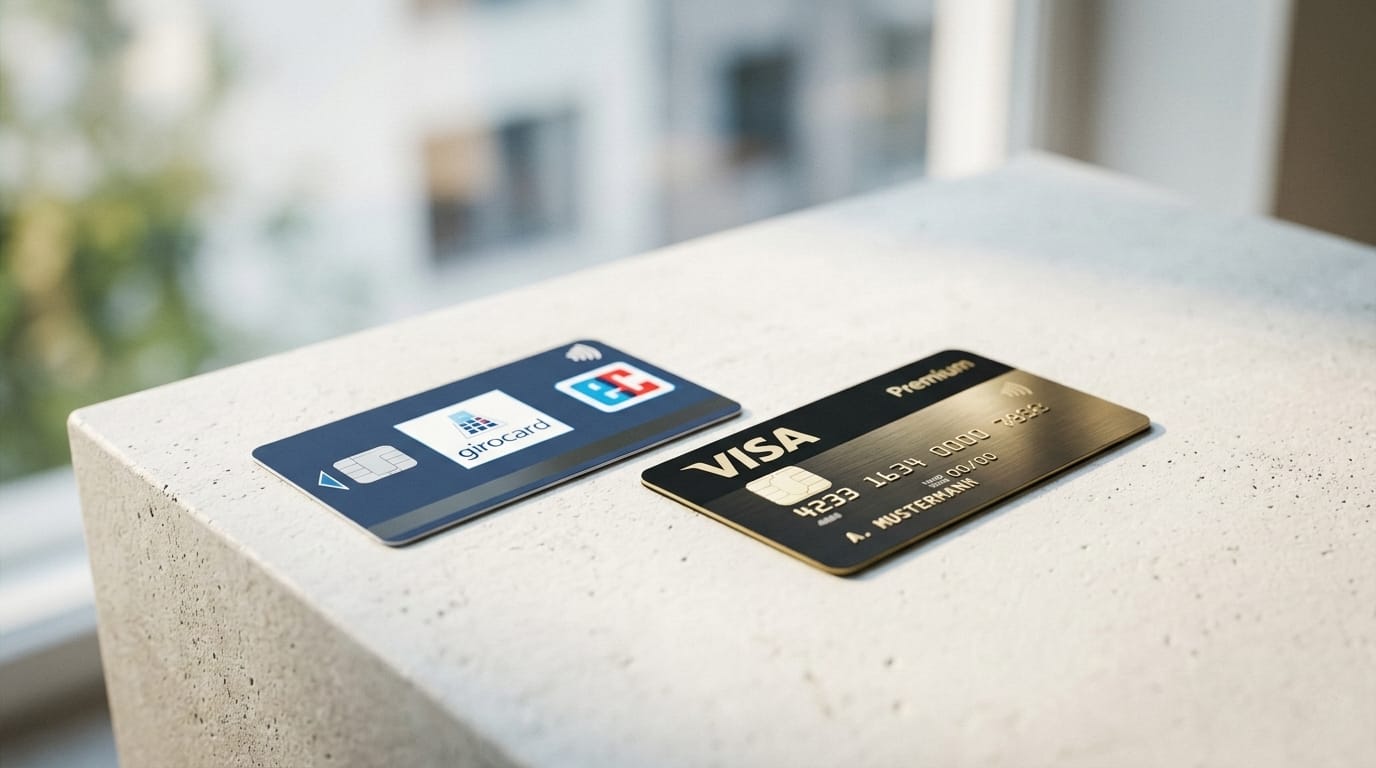
When your German landlord or the bakery cashier tells you to pay with an “EC-Karte,” they are talking about a Girocard.
What is a Girocard?
The Girocard is Germany’s own domestic debit network. It is linked directly to your basic German checking account (your Girokonto).
It is accepted everywhere. There are over 900,000 physical card readers across the country that take it. If you want to survive in rural Germany or smaller mom-and-pop shops, you need one.
But the Girocard has massive, annoying limitations for international folks:
It usually does not have a 16-digit card number on the front.
Because it lacks that number, it is completely useless for global e-commerce. Try buying something on a US website with it, and you will get stuck.
You cannot easily use it to book international flights, reserve rental cars, or hold hotel rooms.
It barely works outside of Germany unless the bank attached a legacy logo like V-Pay or Maestro to the back of it.
What is a Real Credit Card?
A real credit card is your standard global Visa, Mastercard, or American Express.
These have the standard 16-digit numbers. They let you buy things online globally, defer your payments, rent cars in Spain, and hook up perfectly to Apple Pay or Google Pay.
Because we live in a digital world, Visa and Mastercard are slowly eating up the Girocard’s market share. But when you are looking for a true credit card in Germany, you have to know which of the four types you are actually applying for.
The 4 Types of Payment Cards Explained Simply
Germans often use the word Kreditkarte to describe any piece of plastic that pays for things. But legally and functionally, the market is split into four very different categories. Let’s break them down like we are five years old.
1. Charge Cards (The Standard German Way)
This is what most Germans think of when they say “credit card.”
How it works: The bank gives you a credit limit for the month. You buy things. At the end of the 30-day billing cycle, the bank automatically reaches into your checking account and yanks the entire balance out in one single payment.
The catch: Because you cannot carry your debt into the next month, there is zero interest. The bank takes the risk for 30 days, but they make sure they get fully repaid.
Who it is for: Established locals with great credit scores and steady jobs.
Examples: Traditional cards from Commerzbank, Deutsche Bank, or older DKB Visa cards.
2. Revolving Credit Cards (The Anglo-American Way)
This is the style you are likely used to if you come from the US, the UK, or Canada.
How it works: You spend money during the month. When the bill comes, you do not have to pay it all off. You can make a small minimum payment (like 3% of your balance) and “revolve” or carry the rest of the debt into the next month.
The catch: The bank will charge you extremely high interest (Sollzinsen) on the money you didn’t pay back. Because they make so much money off this interest, they usually give you the card with no annual fee.
Who it is for: Expats, frequent travelers, or anyone who wants a free card and is disciplined enough to pay it off manually.
Examples: TF Bank Mastercard Gold, Advanzia Gebührenfrei, easybank Visa
3. Debit Cards (The Neobank Way)
These are the modern disruptors taking over the market.
How it works: You swipe the card, and the money leaves your checking account that exact second.
The catch: They give you the beautiful 16-digit number so you can shop online, but there is no credit line at all. Since the bank takes zero risk, they approve almost everyone.
Who it is for: International students, brand new expats, and people who want to stick strictly to a budget.
Examples: N26, Revolut, Trade Republic.
4. Prepaid Cards (The Guaranteed Way)
Think of these like digital gift cards.
How it works: You load your own money onto the card first. Then you spend it.
The catch: Because you are only spending your own money, there is absolutely no credit check. It is guaranteed approval. However, they usually charge you heavy fees just to own the plastic.
Who it is for: People with destroyed credit scores or absolute beginners who need a card today.
Examples: VIABUY, Bunq Prepaid.
How to Get a Credit Card in Germany When SCHUFA Says No
Alright, we need to talk about the monster under the bed. The ultimate gatekeeper.
SCHUFA.
SCHUFA (Schutzgemeinschaft für allgemeine Kreditsicherung) is a massive private credit bureau. They track the financial heartbeat of nearly every single resident in Germany. They know about your bank accounts, your cell phone contracts, your internet bill, your loans, and any time you have ever missed a payment.
The "Thin File" Expat Paradox
Here is the nightmare for expats. When you arrive in Germany and register your address at the town hall (your Anmeldung), SCHUFA automatically creates a blank file for you.
You might have an incredible 800+ credit score in New York. You might have thousands of dollars in a bank in London.
Germany does not care.
To the German banks, your international history does not exist. You have what the industry calls a “thin file.” Because you have no local track record of paying bills on time, the banking algorithms view you as a high-risk, dangerous unknown.
When you apply for a standard traditional credit card, the computer sees your blank file and instantly auto-rejects you. It punishes you for having no data just as harshly as if you had bad data.
The Massive 2026 SCHUFA Overhaul
For years, SCHUFA was a total black box. Nobody knew how the math worked.
But on March 17, 2026, everything changed. SCHUFA abolished their old, secretive system and introduced a completely transparent model based on exactly 12 specific criteria. You can even download the new SCHUFA app and see exactly how they calculate your score.
Based on the 2026 data, the algorithm loves longevity and stability. Here is what matters most:
The Age of your Accounts: The system looks at your oldest bank account and oldest credit card. It heavily rewards people who stay with one bank for years.
Your Address: It looks at how long you have lived at your current registered address. If you move apartments every six months, your score drops.
Credit Inquiries: This is a huge trap! The algorithm tracks how many current accounts and credit cards you applied for in the last 12 months. If you get rejected for a card, do not panic and apply for five more! Every rejection triggers a “hard inquiry” which actively damages your score further.
Missed Payments: This is the ultimate sin. A documented payment default is the fastest way to ruin your life in Germany.
How to Beat the System
Since you are starting at zero, you cannot apply for the fancy cards right away. You need to build trust.
Path 1: Start with a Neobank. Providers like N26 and Revolut do not run a SCHUFA check for their standard debit accounts because they aren’t lending you money. Get an N26 account to establish your baseline banking history.
Path 2: The Thin-File Friendly Cards. Banks like Advanzia and TF Bank actively target expats. They do check your SCHUFA, but their threshold for approval is incredibly low. They know you are new. They will approve you, but they will only give you a tiny “micro-limit” at first—maybe €100 or €300. Use it to buy groceries, pay it back instantly, and over three to six months, they will scale your limit up to €5,000 or more.
Approval Chances for Expats (Thin File)
The Top Recommendations: 2026 Edition
Let’s look at the actual data and find the best cards for your situation. We are relying strictly on the updated 2026 market structures.
The Best Free Cards for Expats
1. TF Bank Mastercard Gold
The Good: Zero annual fee. Zero foreign transaction fees worldwide. They offer free travel insurance. They are highly likely to approve newcomers to help build your SCHUFA.
The Bad: The interest rate is a massive 24.79%. Also, they do not let you set up an automatic direct debit to pay your full bill. You have to manually log in and wire them the money every month.
2. Bank Norwegian Visa
The Good: Zero annual fee and zero foreign fees. As of 2026, they are offering a €15 welcome bonus. Their mobile app is fantastic and intuitive.
The Bad: The interest rate is 24.40%. Their limits are a bit strict initially.
3. Advanzia (Gebührenfrei Mastercard Gold)
The Good: Zero annual fees and zero foreign fees. This is historically the absolute easiest true credit card for an expat to get approved for. They scale your credit limit up very quickly if you prove you are reliable.
The Bad: The interest rate is 20.63%. Just like TF Bank, there is no automatic direct debit. You must manually transfer the cash from your checking account every single month.
The Best Neobanks (No SCHUFA Required)
If you want an instant digital card without the stress of a credit check, these are your absolute best options right now.
1. N26 Standard Mastercard
The Good: It costs €0 a month. It is 100% digital, sets up in 10 minutes on your phone, and the app is in perfect English. Crucially, it gives you a local German IBAN.
The Bad: They charge high fees if you want to deposit physical cash, and there are obviously no physical branches to visit if you have a problem.
2. Trade Republic Visa Debit
The Good: This app is taking over the German market in 2026. It costs €0. They give you a 1% “Saveback” on everything you buy (they automatically invest 1% of your spending into an ETF for you). Plus, they pay you 2.25% interest on your uninvested cash.
The Bad: The customer support is notoriously terrible, and it is primarily designed as an investment app, not a daily checking account.
3. Revolut Standard Visa/MC
The Good: The ultimate travel card. €0 monthly fee, incredible multi-currency holding vaults, and disposable virtual cards for safe online shopping.
The Bad: It gives you a Lithuanian IBAN. While it legally should work everywhere in Europe, some stubborn German gyms or local utility companies might give you a headache when trying to set up a direct debit.
The Best Premium & Travel Cards
If you have a high income, an established SCHUFA, and love to travel, these are the heavy hitters.
1. Miles & More Gold (Deutsche Bank)
The Good: The best airline rewards card in Europe. In early 2026, Deutsche Bank took over this card from DKB. They kept the best feature: your Lufthansa miles never expire. They also added an amazing new perk of 5GB of global roaming data (Flexiroam). It costs €138 a year (but they waive the first month).
The Bad: You need a rock-solid SCHUFA history to get approved.
2. American Express Platinum
The Good: Elite status. You get incredible global lounge access, €150 in dining credits, and €200 in Sixt rental car credits.
The Bad: The annual fee is a brutal €720 to €850. The foreign transaction fee is 2.0%, and ATM withdrawals cost a massive 4%. Also, American Express is rarely accepted in smaller German towns.
3. easybank Visa
The Good: If you remember the beloved Barclays Visa, this is it. It was acquired and rebranded to easybank in 2026. It is a fantastic free card with a very long grace period and a 100% automated direct debit feature.
The Bad: The rebranding caused some temporary customer service delays.
🟢 Must Read
The Hidden Fee Traps (Read This Carefully!)
I want to protect you like a friend here. The German market loves to advertise things as “100% Free.” But banks are not charities. They make their money through a complex web of hidden penalties.
The "Sollzinsen" Trap
Cards like Advanzia and TF Bank are free because they rely on you making a mistake. They want you to use the partial payment function.
If you do not pay your entire balance off at the end of the month, they hit you with Sollzinsen (debit interest). Right now, thanks to the European Central Bank, those rates are hovering around 20% to 25% a year.
Because neither of these cards allows for an automated direct debit, you have to set a calendar alarm on your phone to remind yourself to wire the money manually. If you forget, they cash in.
The Cash Withdrawal Loophole
This is the single biggest mistake expats make. Please remember this.
You will see cards advertising “Free Worldwide ATM Withdrawals!”
This is technically true. The bank will not charge you a flat €5 fee to use the machine.
However, they trigger a massive loophole. Normally, when you buy groceries with these cards, you get a 44 to 51 day interest-free grace period. But the second you withdraw physical cash from an ATM, that grace period is instantly destroyed.
Up to 45 Days Interest-Free Grace Period.
0 Days Grace Period. High Interest starts instantly.
Interest begins compounding daily from the exact moment the cash spits out of the machine until your entire bill is paid off.
Let me give you a real scenario. You go to Italy. You use your Advanzia card to take €1,000 out of an ATM. You think, “Great, no ATM fee!” You wait 30 days for your normal monthly bill to arrive, and then you pay it in full.
Surprise! The bank will charge you roughly €17 to €20 in pure interest just for those 30 days you held the cash. You never missed a deadline, but you still got penalized.
The Golden Rule: Never, ever use a revolving credit card to pull cash out of an ATM. Always use your Girocard or your N26 debit card for cash.
Late Penalties (Mahngebühren)
If you miss a payment, the bank will send you a warning letter called a Mahnung.
German consumer law protects you here. They cannot charge you €50 for a late fee. The law says they can only charge you for the stamp and the paper. For example, Bank Norwegian only charges €2 for their first reminder letter.
Sounds harmless, right?
Wrong. The €2 fee doesn’t matter. What matters is that the bank immediately reports your missed payment to SCHUFA. That one tiny mistake becomes a “payment disruption.” It will tank your credit score, making it nearly impossible for you to rent a new apartment or get a cell phone contract for years.
Step-by-Step: How to Actually Apply
Okay, you picked your card. How do you get it? Due to strict anti-money laundering laws (the GwG), the bank has to prove you are exactly who you say you are.
What you must have ready:
You must be 18.
A valid Passport. (Non-EU citizens also need their residence permit / Aufenthaltstitel).
An existing checking account IBAN.
Your Anmeldung. This is the holy grail. It is the municipal certificate proving you live at a physical address. Without this piece of paper, you do not exist in the banking system.
When you apply online, you will be asked to verify your identity. You have two choices:
1. PostIdent (The Old School Way) You print out a barcode, grab your passport and Anmeldung, and walk down to the local Deutsche Post office. A grumpy postal worker looks at your face, looks at your passport, stamps a paper, and sends the data to the bank. It is highly reliable, but it takes 12 to 48 hours to process.
2. VideoIdent (The Fast Way) You download an app like IDnow. You get on a quick 10-minute video call with an agent. They will ask you to wave your hand in front of your face and tilt your passport into the light so they can check the shiny holograms. They text you a code, you type it in, and your bank account is opened instantly. It is amazing, but you need good Wi-Fi and a modern passport.
Future Trends: What is Coming Next?
The market is changing fast. If you are reading this in late 2026, you will notice two massive trends taking over.
Buy Now, Pay Later (BNPL)
Younger Germans absolutely love Klarna and PayPal installments. By the end of this year, BNPL is expected to make up 10% of all retail payments. Why? Because it offers zero-interest, predictable installments. It lets Germans buy things on credit without feeling the psychological “guilt” of an open-ended American credit card.
The Wero Wallet
This is a huge deal. The European Union is tired of relying on American companies like Visa, Mastercard, and Apple. In 2026, major European banks rolled out the Wero digital wallet.
It runs on instant bank transfers. You will soon be able to pay at the grocery store directly from your phone’s Wero app, completely bypassing the need for a physical plastic credit card at all.
You Have Got This
Navigating the German financial system can feel like learning a completely different language. The cash culture is deeply ingrained, SCHUFA feels unfair, and the hidden fees are annoying.
But now you know the rules of the game. You understand the difference between a Girocard and a true credit card. You know exactly how to avoid the Sollzinsen trap, and you know which 2026 cards are designed specifically to help you build your new life here.
Go open that first account, build your credit slowly, and the next time you walk into that bakery, you will know exactly what piece of plastic to hand them. Enjoy that pretzel!