Imagine this. It is the first week of January 2026.
You are sitting at your kitchen table. The holiday decorations are arguably still up, and the festive cheer is fading into the reality of a new year. You have your banking app open on your phone, reviewing your finances for the year ahead. You’ve worked hard for these savings—perhaps for decades. But every time you go to the supermarket in Milan or Rome, you feel the pinch. The price of olive oil, electricity, and even your morning espresso has crept up again.
You look at your traditional bank savings account, and the interest they are giving you is barely enough to buy a pizza once a year. It feels like you are running on a treadmill—working hard to save, but staying in the same place financially because inflation is quietly eating away at your purchasing power.
I hear this frustration every single day from my clients. The fear is real. The question in 2026 is always the same: “Arman, where can I put my money so it is safe, but actually grows faster than the cost of living?”
For a long time, the answer was complicated or risky. But as we settle into 2026, the solution has become surprisingly simple, accessible, and closer to home than you might think. It is the Borsa Italiana BTP.
You might be thinking, “Government bonds? Aren’t those boring? Aren’t they risky given Italy’s debt?”
Let me stop you right there. That was the old way of thinking. The landscape has changed dramatically. We are currently seeing a “Goldilocks” moment for Italian sovereign debt—a sweet spot where yields (Rendimenti) are attractive, risks are moderating due to ECB support, and the tax benefits are too good to ignore. This isn’t just about lending money to the state; it’s about securing your family’s financial future with a tool designed specifically for people like you.
Table of Contents
ToggleThe New Reality: Understanding the Borsa Italiana BTP Market Landscape
o make a smart decision, we first need to look at the cold, hard numbers. As a financial analyst, I don’t trust feelings; I trust data. And the data coming out of the Mercato Obbligazionario Telematico (MOT) in early 2026 is telling us a very specific story.
The "New Normal" in Yields (Rendimento BTP)
For years, we lived in a world of zero interest rates. Putting money in bonds felt pointless. That era is officially over.
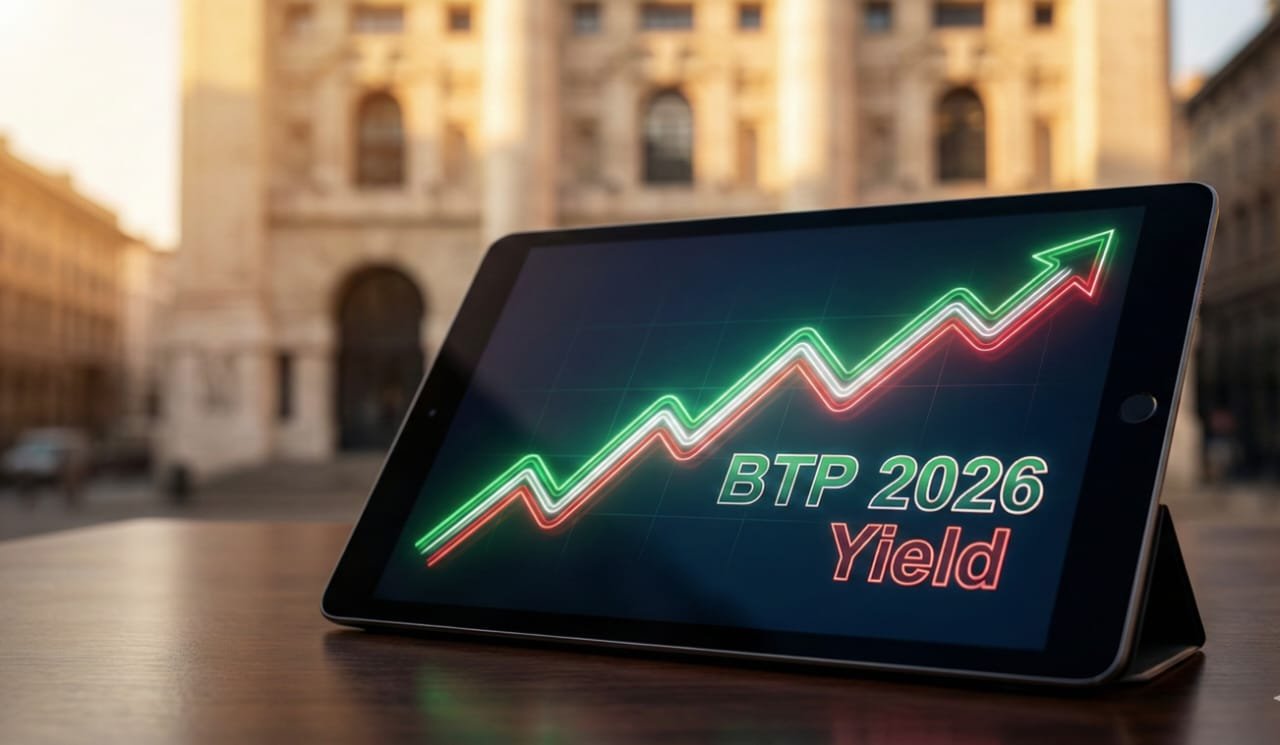
As of January 2026, the benchmark 10-year BTP is offering a yield significantly higher than what you will find in a standard German Bund or a French OAT. While German Bunds are hovering around 2.30%, the Borsa Italiana BTP is offering an annual return (Rendimento) of approximately 3.45% to 3.50%.
Let that sink in. This is a solid, predictable return. It is not the volatile rollercoaster of the stock market, nor is it the near-zero return of a checking account. It is a steady stream of income.
The Spread Factor: Right now, the spread (the difference between Italian and German yields) is hovering around 105-110 basis points. This is incredibly low compared to the crisis years. It signals that the international financial community views Italy as stable. The fear premium has evaporated, but the extra yield for you remains.
The ECB's "Safety Net"
You might be wondering, “What about the European Central Bank (ECB)? Will they let Italy fail?”
This is crucial to understand in 2026. Back in late 2025, the ECB decided to hold its key deposit rate steady around 2.00%. Now, as we move through early 2026, they have stopped raising rates because inflation is finally cooling down to around 1.7%.
This creates a perfect environment for bondholders. Since interest rates have plateaued, the prices of bonds are stabilizing. We aren’t expecting the vicious price drops we saw back in 2022. Instead, we have a stable market where you lock in yields that beat inflation.
The Real Protection: The ECB effectively put a floor under the market with the “Transmission Protection Instrument” (TPI).
Think of TPI as an insurance policy. It is a tool they have locked in place to stop spreads from widening too much. It essentially means there is a safety net in place in 2026 that didn’t exist a decade ago. If speculators try to attack Italian debt, the ECB has the power to step in immediately.
The Moody's Stamp of Approval
If you needed one more reason to sleep soundly, look at what the credit rating agencies did just a couple of months ago.
In November 2025, Moody’s upgraded Italy’s credit rating outlook to “Stable” (Baa2). This was a massive win for the Borsa Italiana BTP.
It essentially told the world: “Italy is getting its house in order.” Political stability and the proper use of European recovery funds (PNRR) have restored credibility.
Why this matters for you in 2026: When Moody’s speaks, big institutional investors listen—and right now, they are buying. When the “Smart Money” (pension funds, insurance companies) is buying BTPs, it creates price stability for retail investors like us. You are not swimming against the tide; you are swimming with the whales.
Why Smart Investors Are Choosing Borsa Italiana BTP Right Now
It’s not just about the raw numbers. It’s about how these bonds fit into your life in 2026. Let’s look at the specific benefits that are driving Italian families to move billions of Euros from stagnant bank deposits into Borsa Italiana BTP.
1. The BTP Valore Phenomenon
If you want a clear example of how the Italian Treasury is courting you, look no further than the BTP Valore. This instrument was designed exclusively for retail investors—people like you and me, not hedge funds.
The issuance back in October 2025 was a blockbuster for a reason. Why? Because the terms were irresistible for someone looking for income security. As we head into 2026, the demand for these “retail-only” bonds is higher than ever.
How it works for you:
Step-Up Coupons: It pays you more the longer you hold it. For example, recent issues started at around 2.60% for the first few years and rose to 4.00% for the final years. It rewards your patience.
Loyalty Bonus (Premio Fedeltà): If you buy it at issuance and hold it to maturity, the state pays you an extra 0.8% bonus on your capital. It is effectively a “thank you” note from the government, attached with cash.
2. The Unbeatable Tax Advantage
This is the secret weapon of the Borsa Italiana BTP. In Italy, taxes on financial gains can be heavy—usually 26% for stocks, bank accounts, and corporate bonds.
But BTPs are special. They are subject to taxation (Tassazione BTP) at a preferential rate of only 12.5%.
Let’s do the math to see the real difference in 2026: If you earn €1,000 in interest from a corporate bond or a locked bank account, the government takes €260. You keep €740.
If you earn that same €1,000 in interest from a Borsa Italiana BTP, the government takes only €125. You keep €875.
The Bottom Line: That is an instant, guaranteed gain of over €135 just by choosing the right instrument. Over ten years, that tax difference alone can add up to a small car or a significant home renovation. Why pay more tax than you legally have to?
3. The "Minusvalenze" Strategy (Tax Loss Harvesting)
Here is a scenario I see often in my office: A client bought technology stocks or reckless ETFs back in 2024 or 2025 and sold them at a loss when the market dipped. Now they have a “fiscal credit” (minusvalenza) in their tax drawer.
The problem? You cannot use dividends or ETF distributions to offset these losses. You need “Redditi Diversi.”
This is where buying Borsa Italiana BTP bonds trading below par (under 100) becomes a magic trick. If you buy a bond at a price of 95, and it matures at 100, that 5-point gain is considered a capital gain that can cancel out your previous losses.
Actionable Tip for 2026: Look at the BTP 0.5% July 2028. Since general interest rates in 2026 are higher than 0.5%, this specific bond trades at a discount (“Sotto la pari”).
If you buy this today (trading significantly below 100, often around the 95-96 range), you lock in a guaranteed capital gain when it matures in 2028. You pay less tax, recover your old losses, and park your money safely. It is the smartest way to clean up your fiscal position while waiting for the market to stabilize.
See More Article for
How to Buy Borsa Italiana BTP: A Step-by-Step Guide
Many people are intimidated by the idea of “buying bonds.” They think they need to call a broker in a suit or go to a physical bank branch and sign a mountain of paper.
The reality in 2026 is much simpler. The Borsa Italiana BTP market (specifically the MOT) is fully digital and accessible from your phone or laptop.
Step 1: Log in to Home Banking
Almost every Italian bank account offers a “Trading” or “Investments” section. You do not need a special professional account. Just log in.
Step 2: Find the ISIN
Every bond has a unique code called an ISIN (International Securities Identification Number). This is like the bond’s fingerprint.
Want the 10-year benchmark? You search for the current On-the-Run 10Y ISIN.
Want the tax-efficient bond I mentioned? Search for IT0005445306 (BTP 0.5% Jul 28)
Step 3: Check the Price (Corso Secco)
You will see a price, likely something like “99.50” or “101.20”.
If it’s below 100 (Under Par): You pay less than the face value. You invest €995 to get a bond worth €1,000. This is great for capital appreciation.
If it’s above 100 (Over Par): You pay a premium, usually because the coupon (interest rate) is higher than the current market rate.
Step 4: Click Buy
Enter the “Nominale” (the face value amount you want to buy, usually in multiples of €1,000). The system will calculate the total cost, including the accrued interest (rateo) that you pay to the previous owner. Confirm, and it’s done. The bond is in your portfolio, and the coupons will automatically appear in your account every six months.
Risks vs. Rewards: An Honest Look at Borsa Italiana BTP
I promised you I would be honest. No investment is 100% risk-free. Even though BTPs are considered “safe haven” assets for Italians, you must understand the risks to manage them.
The Debt Monster
we move through 2026. That is a big number. It simply means the country owes more than it produces in a year.
The Risk: If Italy’s economy stops growing or if the government spends recklessly, this debt becomes harder to sustain.
The Reality in 2026: However, as Moody’s noted recently, the trajectory is stable. Italy is currently running a “primary surplus” (earning more than it spends before interest payments). As long as the economy grows slightly and the ECB supports the market, this debt is manageable. You aren’t betting on Italy becoming debt-free; you are betting on Italy remaining solvent. Given the EU support, that is a very safe bet.
The Inflation Trap
Fixed-rate BTPs pay you the same coupon regardless of what happens to prices at the supermarket.
The Risk: If inflation spikes back up to 8% or 10% (like in 2022), your 3.45% coupon will feel worthless. You will lose purchasing power.
The Solution: Do not put 100% of your money in fixed rates. allocate a portion (say, 20-30%) to BTP Italia. These are bonds indexed to inflation. If inflation goes up, your return goes up. They are your insurance policy.
The "Mark-to-Market" Fear
BTP today at 100. Tomorrow, interest rates rise, and the price of your bond on the screen drops to 95. You see a “loss” in red numbers on your banking app.
The Reality: This is only a “paper loss.” If you hold to maturity, you get 100 back. Period. Daily price fluctuations only matter if you need to sell the bond before it matures.
The Strategy: Match the maturity to your goals. If you need the money in 2028 for your daughter’s wedding, buy a BTP that matures in 2028. Do not buy a 2072 bond just because it has a high yield, or you might be forced to sell at a loss when you need the cash.
Conclusion: Take Control of Your Savings
We are living through a unique window of opportunity. The financial storms of the last few years have cleared, leaving us with a Borsa Italiana BTP market that is offering healthy, reliable returns for the first time in a decade.
You have two choices as you sit at that kitchen table planning for the year ahead:
You can leave your money in the bank, where inflation will slowly erode its value year after year. It’s the “safe” choice that guarantees you become slowly poorer.
Or, you can take a small step toward financial empowerment. You can lend your capital to the state, secure a 3.45% to 4% return, pay less tax, and sleep well at night knowing your purchasing power is protected.
The tools are there. The BTP Valore (stepped-up income) and the BTP Italia (inflation protection) are designed for you.
Don’t let the technical terms scare you away. Buying a BTP is an act of trust in the future—your future. Look at your portfolio today. If you see too much cash doing nothing, log into your bank, search for “Borsa Italiana BTP” and put your money to work.
Your future self—sitting at that same kitchen table in 2030—will thank you for it.
People Also Ask (Domande Frequenti)
What is the current "BTP Rendimento" (Yield)? +
As of January 2026, the gross yield (rendimento lordo) for the benchmark 10-year BTP is stabilizing around 3.45% to 3.50%.
Net Yield Reality: Because BTPs enjoy a preferential tax rate of only 12.5% (compared to 26% for bank accounts), your effective take-home return is significantly higher than most corporate bonds. For shorter durations (5-year), yields are hovering near 3.00%.
BTP Cosa Sono? (What are BTPs?) +
"BTP" stands for Buoni del Tesoro Poliennali. They are medium-to-long-term Treasury bonds issued by the Italian government to finance public debt.
In 2026, they remain the backbone of Italian savings. When you buy a BTP, you are essentially lending money to the Italian state in exchange for regular interest payments (coupons) every six months and the return of your full capital at maturity.
Why is "BTP Valore" so popular right now? +
The BTP Valore has become a favorite in 2026 because it is designed exclusively for retail investors (people like you), not big banks.
Its popularity comes from two unique features: Step-Up Coupons (rates that increase over time) and a final "Loyalty Bonus" (extra cash paid if you hold to maturity). It offers a higher level of protection and reward compared to standard bonds.
Is the "BTP 2072" a good investment? +
Proceed with Caution. The "BTP 2072" (maturing in 50 years) is famous for its high volatility. While it can offer high gains if rates drop, it can also crash in price if rates rise slightly.
2026 Advice: Unless you are an experienced trader comfortable with large price swings, we recommend sticking to maturities between 5 and 10 years for a safer, more stable income.
BTP Come Funziona: How does it work? +
It is simpler than ever in 2026. You can buy them through any Italian bank or post office with a securities account, or simply via Online Home Banking.
You can purchase them during an auction (primary market) or anytime on the MOT (secondary market). Once purchased, you receive interest payments automatically every six months directly into your account. At the end of the term, the state repays your initial investment (e.g., €1,000 per bond).
What is "BTP Green"? +
BTP Green bonds are sovereign securities used specifically to finance Italy's ecological transition (like renewable energy and energy efficiency projects).
Financially, they work exactly like traditional BTPs (same guarantees and the same 12.5% tax rate), but they allow investors to support sustainability goals while earning a solid return.