If you are feeling completely overwhelmed by the French banking system right now, trust me, you are not alone. Pull up a chair, grab a café crème, and let’s talk.
You moved to France for the food, the culture, the beautiful language, or maybe a great job. But right now, you are probably buried under a mountain of paperwork that makes absolutely no sense. You are facing the ultimate French nightmare: The Chicken and Egg Trap.
To rent an apartment in France, you need a French bank account. To get a French bank account, you need a French address. To get paid by your French employer, you need a French bank account. But to open that account, the traditional banks want to see three months of French payslips.
It makes you want to pull your hair out. I get it. I have been there. (If you are completely new to this process, I highly recommend reading my complete step-by-step guide on how to open a bank account in France before choosing a bank.)
Traditional French banks—the ones with physical branches on every corner—will gladly charge you an average of €224.30 every single year just to keep a basic checking account open. If you want a premium card, they will happily charge you over €349.30. And you still have to deal with grumpy advisors and limited opening hours.
Enter the digital banks. They promise zero fees, slick mobile apps, and freedom from the physical branch. In 2026, two massive heavyweights dominate this space. Everyone talks about them.
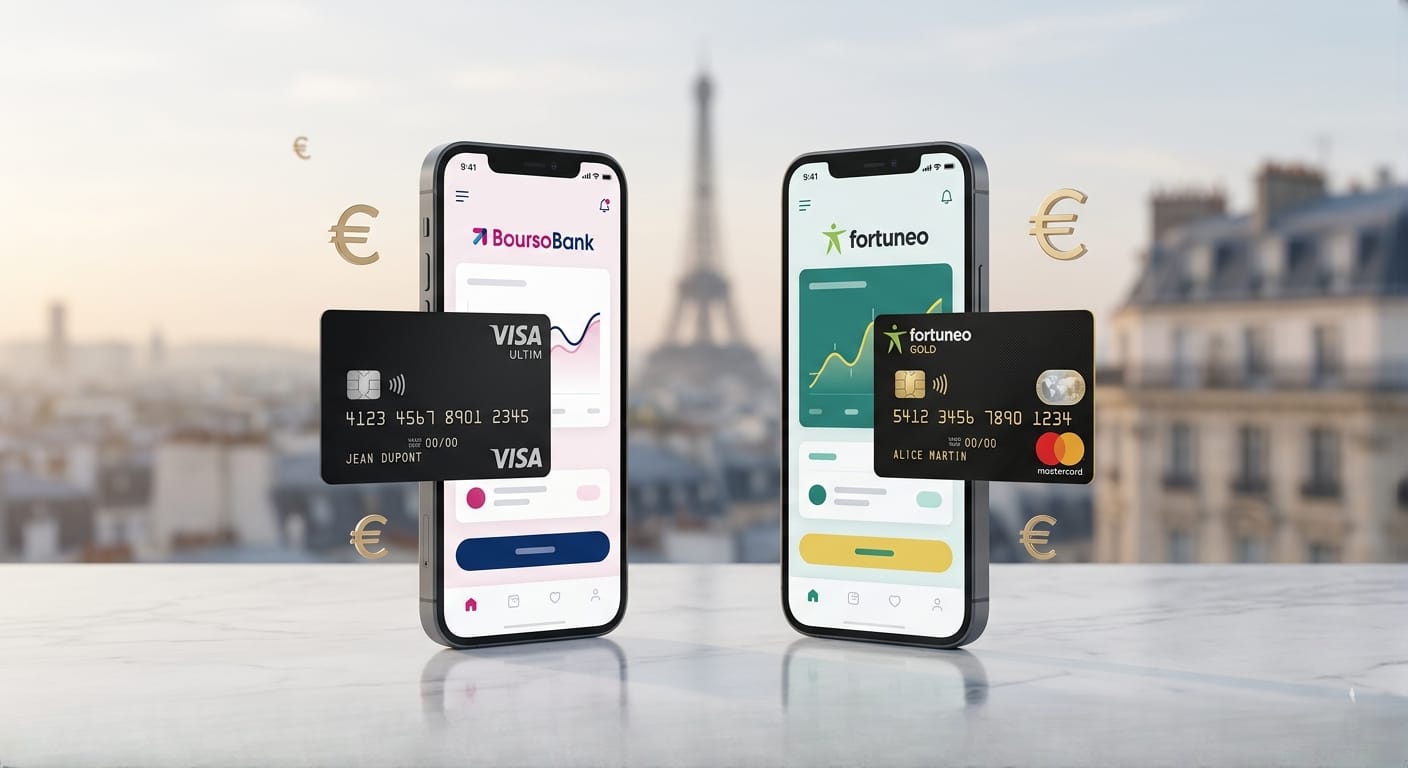
Today, we are looking at the ultimate showdown: BoursoBank vs Fortuneo.
But here is the absolute, honest truth. These banks are amazing, but they are not perfectly equal. And for an expat, an international student, or a foreign worker, opening an account with them can feel like running an obstacle course blindfolded.
Let’s break down exactly how these two banks work, what they hide in their fine print, and which one will actually let you open an account. I will explain everything so simply that a 10-year-old could understand it.
Table of Contents
ToggleThe Core Difference: Who Are These Guys?
Before you hand over your hard-earned money, you need to know who you are actually dealing with. Many online banks pop up, burn through investor cash, and disappear. You do not have to worry about that here. Both of these platforms are backed by massive, legacy French banking giants. That means your money is safe.
BoursoBank: The Aggressive Giant
BoursoBank used to be called “Boursorama Banque” until they changed their name recently to sound sleeker and more modern. They want to be the ultimate mobile app that handles your whole life.
Who owns them? Société Générale. This is one of the biggest banking groups in all of Europe. Because they have so much money behind them, BoursoBank spends wildly to get new customers. They often throw cash bonuses of up to €130 at you just for opening an account.
They proudly wear the crown of the “least expensive bank in France.” They want everyone: students, young professionals, and newly arrived expats who need a financial lifeline right now.
Fortuneo: The Exclusive Club
Fortuneo has a very different vibe. They are owned by Crédit Mutuel Arkéa, a highly respected, traditional cooperative bank based out of the Brittany region in the west of France.
While BoursoBank wants everyone, Fortuneo plays hard to get. They target a slightly wealthier crowd. They want executives, seasoned investors, and people who travel the world constantly. They frequently win awards like “Best Bank for Traveling Abroad.”
Fortuneo does not rely on massive sign-up bonuses. Instead, they lure you in with premium travel insurance, high-end investment platforms, and top-tier Mastercard networks. But as we will see soon, they have incredibly strict rules about who they let inside the club.
🟢 Must Read
BoursoBank vs Fortuneo: The Card Tiers Explained Simply
Traditional banks charge you a flat monthly fee just to have a plastic card in your wallet. Digital banks give you premium cards for “free.”
But how does that work? They use a tiered system based on how much money you make or how often you use the card. Let’s look at the menus.
The BoursoBank Menu (Visa Only)
BoursoBank uses the Visa network. They offer three specific cards.
1. The Welcome Card (Visa Classic) Think of this as your starter pack. It is built for students, freelancers, or anyone who does not have a steady, predictable paycheck yet.
Monthly Fee: €0.
Income Needed: Zero. You do not need to prove you make a single cent.
How it Works (Immediate Debit): This is super important. When you buy a coffee, the card instantly asks the BoursoBank computer: “Does this person have €3 in their account?” If yes, the payment goes through. If no, it is declined. You cannot overdraft. This keeps you safe from debt.
Limits: You can spend up to €5,000 every 30 days and withdraw €500 from an ATM every 7 days.
2. The Ultim Card (Visa Premier Equivalent) This is their heavy hitter. It competes directly with the expensive gold cards at traditional banks.
Monthly Fee: €0.
Income Needed: Zero, as long as you stick to “Immediate Debit” (where the money leaves your account instantly).
The “Deferred Debit” Catch: Deferred debit means all your card purchases wait and get pulled from your checking account on one single day at the end of the month. It is like a traditional credit card. To get this feature, BoursoBank makes you prove you have stable finances. For an expat, you usually need to wait 3 months and show a steady cash flow before they let you have it.
Limits: You can spend up to €20,000 every 30 days and withdraw €2,000 every 7 days.
3. The Metal Card (The Premium Beast) This is the only BoursoBank card that actually costs money every month. It is built for digital nomads and high earners.
Monthly Fee: €9.90.
Income Needed: None, because you are paying the monthly fee.
Perks: Massive limits (€50,000 spending). It comes with ultra-premium travel insurance covering up to €6,500,000. It even gives you free airport lounge access if your flight is delayed.
The Fortuneo Menu (Mastercard Only)
Fortuneo uses the Mastercard network. Their system is completely different. They actively judge you based on your proven income before they even let you have a card.
1. The Fosfo Card This is Fortuneo’s answer to young, modern internet banks. It glows in the dark (yes, really).
Monthly Fee: €0.
Income Needed: Zero. This is the only Fortuneo card you can get without proving a high salary.
How it works: Immediate debit only.
Limits: You can spend €2,000 a week and withdraw €500 a week.
2. The Gold CB Mastercard This is the holy grail for the French middle class. It is a fantastic card, but it comes with a massive catch for expats.
Monthly Fee: €0.
Income Needed: You must prove you make €2,200 net every single month.
The Expat Trap: You cannot just show them a shiny American or British employment contract. Fortuneo demands your official French tax returns or your last two official French payslips. If your income comes from outside of France, their computer system will reject you instantly.
3. The World Elite CB Mastercard This is the exclusive “black card.” It gives you a 24/7 personal concierge and crazy high insurance coverage.
Monthly Fee: €0, but conditionally.
Income Needed: You must prove you make €4,000 net per month when you apply.
The Brutal Catch: To keep this card free, you MUST transfer €4,000 into your Fortuneo account every single month. If you miss a month, they hit you with massive penalty fees. Do not get this card unless your salary automatically drops into this account.
Hidden Fees & The "Inactivity" Trap
You might be asking yourself: “If these cards are free, how do these banks make any money?”
It is simple. Every time you tap your card at a grocery store, the merchant pays a tiny invisible fee to the bank. If your card sits in a drawer gathering dust, the bank makes zero money. In fact, a dusty card costs them money to maintain.
So, they set a trap. It is called the “Inactivity Fee.”
The Inactivity Penalties
BoursoBank: They used to be strict about this, but in 2026, they softened up. The entry-level Welcome card is entirely free with no usage conditions. You can leave it in your drawer for a year, and they will not charge you a cent. However, the Ultim card still requires you to make purchases, or they will charge you standard penalty tariffs.
Fortuneo: They are absolutely ruthless about inactivity. If you have the Fosfo or Gold card, you MUST buy something with it at least once a month. (Withdrawing cash at an ATM does not count). If an entire month goes by and you buy nothing, they will automatically charge you €3 for the Fosfo or €9 for the Gold the very next month.
Foreign Transaction Fees (The Expat Pain Point)
If you travel outside of Europe, or if you go back home to the UK or the US for the holidays, you need to know how these banks handle foreign currencies. This is a massive part of the BoursoBank vs Fortuneo debate.
(After monthly quota is used)
(Anytime, anywhere in the world)
BoursoBank’s Quota System: Paying with your card in a shop in London or New York is 100% free across all their cards. But the ATMs are a trap. With the Welcome card, you get exactly 1 free ATM withdrawal outside of Europe per month. With Ultim, you get 3. If you withdraw cash after that, BoursoBank slaps you with a nasty 1.69% fee on your money.
Fortuneo’s Ultimate Freedom: Fortuneo completely destroys the competition here. With any of their cards (even the basic Fosfo), all payments and all ATM withdrawals in any currency worldwide are 100% free and unlimited. There are no quotas to track. There are no sneaky 1.69% fees. It is beautiful.
Let's Look at the Data Side-by-Side
| Feature & Metric | BoursoBank Welcome | BoursoBank Ultim | Fortuneo Fosfo | Fortuneo Gold |
|---|---|---|---|---|
| Payment Network | Visa | Visa | Mastercard | Mastercard |
| Base Monthly Fee | €0 | €0 | €0 | €0 |
| Income Needed | None | None | None | €2,200 net/month (French) |
| Inactivity Penalty | €0 | Conditional fee | €3/month (if 0 purchases) | €9/month (if 0 purchases) |
| Non-Euro Payments | Free | Free | Free | Free |
| Non-Euro Withdrawals | 1 free/mo (then 1.69%) | 3 free/mo (then 1.69%) | Free & Unlimited | Free & Unlimited |
| Rejected Direct Debit | €20 fee | €20 fee | €20 fee | €20 fee |
The Expat Gauntlet: Why Opening an Account Makes You Want to Cry
This is the most critical section of this entire guide. Everything we talked about above does not matter if the bank refuses to open your account in the first place.
Because online banks do not have physical branches where a human can look at your passport, their computers are incredibly strict. They are terrified of money laundering. For an expat, getting past the computer is a nightmare.
The RIB Paradox
To prove you are a real person, French online banks make you send a small initial deposit (usually between €50 and €300) from an existing bank account in your name. They need the official document showing your bank details. In France, this document is called a RIB (Relevé d’Identité Bancaire). It holds your IBAN number.
BoursoBank is your best friend here. They accept an initial deposit from ANY bank account in the European Economic Area (EEA), the UK, or Switzerland. Are you British with a Barclays account? You are approved. Are you an international student with a Belgian Wise account or a Lithuanian Revolut account? You are approved. This is a life-saver.
Fortuneo is completely unreasonable. To open a Fortuneo account, the deposit MUST come from a bank physically located in France. Read that again. To get a French bank account with Fortuneo, you must already have a French bank account. It is the ultimate Catch-22. You absolutely cannot use Fortuneo as your very first bank in France.
Immigration Documents: Titre de Séjour vs Récépissé
When you arrive in France, you get a visa. Then, you apply for a residence permit (Titre de Séjour). While you wait for the shiny plastic card, the government gives you a fragile paper receipt called a “récépissé.”
BoursoBank: They will accept your standard 1-year plastic Titre de Séjour. You just scan the front and back. However, their computer hates the paper récépissé. It will usually reject it. You have to wait until you get the physical plastic card from the local Prefecture before applying.
Fortuneo: Their policy is incredibly hostile to foreigners. For non-EU citizens, Fortuneo flat-out rejects the standard 1-year residence permits. Their official legal rules clearly state: “(pas de carte de séjour).” They demand a permanent 10-year resident card. This means almost all international students and temporary workers are banned from Fortuneo right from the start.
The American Problem: The FATCA Minefield
If you are a US Citizen (or a Green Card holder), you have a massive target on your back. The US government has a law called FATCA. It forces foreign banks to report all your money directly to the IRS. If the bank makes a mistake, the US government fines the bank heavily.
Because of this, many European banks simply refuse to deal with Americans.
BoursoBank: They do not explicitly say “No Americans,” but their automated sign-up software will usually shadow-ban you. When you type in that your place of birth is the United States, the computer often freezes or rejects the application because it doesn’t know how to ask you for your US Social Security Number.
Fortuneo: Surprisingly, Fortuneo wins here! Even though they hate temporary visas, they actually have a legal, official pathway for US Citizens. They will officially ask you to fill out a W-9 tax form and provide your US Tax Identification Number. It is a lot of paperwork, but they will not illegally block you just for being American.
App Experience & Language: Do You Speak French?
These banks have spent hundreds of millions of euros making their mobile apps beautiful. But there is a massive catch.
Absolutely everything is in French. Yes, the app store might show a description in English. Do not be fooled. Once you download the app, every menu, every legal contract, and every single customer service agent is strictly speaking French.
If your account gets locked because the computer suspects fraud, you cannot call an English helpline. You will have to navigate a complex French phone menu and try to explain international wire transfers to a French agent. BoursoBank relies heavily on an AI chatbot named “Eliott.” Arguing with a French robot about your blocked rent money is an experience I do not wish on my worst enemy.
The Magic of Virtual Cards
Both apps are brilliant at security.
BoursoBank: The absolute best feature is that the moment your account is approved, they give you a digital card in the app. You can add it to Apple Pay or Google Pay immediately. You can start paying for groceries weeks before the physical plastic card arrives in your mail.
Fortuneo: They offer “ephemeral” virtual cards. If you want to buy something sketchy online, Fortuneo will generate a fake card number that works exactly one time. Once the purchase is done, the number self-destructs. It makes it impossible for hackers to steal your card details.
A Quick Note on Savings & Taxes (Read this if you are American)
Once you are set up, both banks offer great savings accounts. You can open a Livret A directly in the app. This is a magical, state-regulated savings account that gives you around 3% interest, and the French government guarantees it is 100% tax-free.
They also offer amazing investment accounts called PEA (for stocks) and Assurance Vie (life insurance wrappers for mutual funds).
Warning for US Citizens: Do not touch the PEA or the Assurance Vie. The IRS views standard European mutual funds as “PFICs” (Passive Foreign Investment Companies). If you buy them, the US government will hit you with tax penalties so severe they will make your head spin. Keep your French banking strictly to checking accounts and basic cash savings.
The Final Verdict on BoursoBank vs Fortuneo
So, who wins the great BoursoBank vs Fortuneo battle? Let’s be brutally honest.
BoursoBank is amazing because:
You can open it with a UK or European bank account (No French Catch-22).
They don’t care how much money you make to give you a basic card.
They accept standard 1-year expat residence permits.
You get instant Apple Pay before the physical card arrives.
The Welcome card has zero inactivity fees.
BoursoBank is terrible because:
You get hit with a 1.69% fee if you use ATMs outside Europe too often.
Getting a deferred debit card takes months of waiting.
Their system shadow-bans Americans automatically.
Fortuneo is amazing because:
Zero foreign transaction fees worldwide. Period. It is a traveler’s dream.
They actually follow the law and let US citizens open accounts with W-9 forms.
Their single-use virtual cards make online shopping incredibly safe.
Fortuneo is terrible because:
You MUST already have a French bank account to apply.
They actively reject standard 1-year residence permits.
You need to prove a high French salary to get the good cards.
If you don’t use the card every month, they drain your account with penalty fees.
The Step-by-Step "Strategic Sequencing" Strategy
After looking at all the data for 2026, there is only one logical way for an expat to handle this. Do not try to pick one forever. You must use a strategy called “Strategic Sequencing.”
Step 1: The Wedge (Start with BoursoBank) When you first arrive in France, your only goal is survival. You need a French RIB immediately to get an apartment and a phone plan. Apply for the BoursoBank Welcome card. Use your home country’s bank account (like a UK account or a Wise account) to make the initial deposit. Upload your 1-year Titre de Séjour. Boom. You are in the system. You have a French RIB.
Step 2: The Waiting Game Live your life. Work your job. Pay your taxes in France. Wait until you get your permanent resident card and your official French tax returns.
Step 3: The Graduation (Move to Fortuneo) Once you have your French tax returns and you are earning over €2,200 a month, use your BoursoBank RIB to apply for the Fortuneo Gold Mastercard. Now you have a premium card that gives you absolutely free ATM withdrawals and payments anywhere in the world.
Keep the BoursoBank card in a drawer as a free backup, and travel the world with your Fortuneo card.
Welcome to France. You finally beat the system.