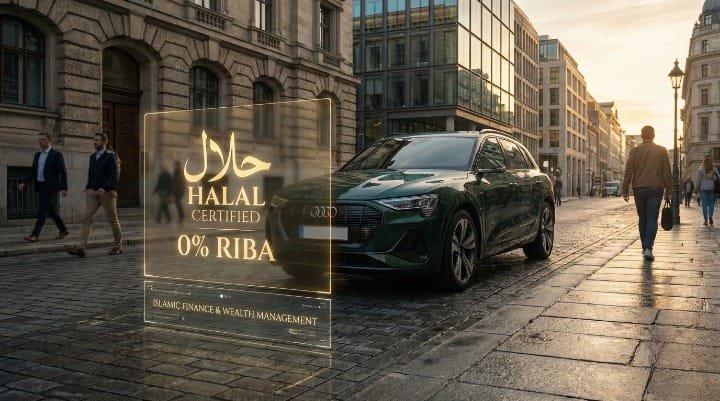
For millions of Muslims living across Europe and the UK, the desire to own a car is often met with a deep spiritual dilemma. The traditional method of purchasing a car through an interest-based loan (HP, PCP, or bank loan) is fundamentally in conflict with their faith. The prohibition of Riba—interest or usury—is not merely a financial preference in Islam; it is a core tenet, a spiritual command that governs how we conduct our worldly transactions.
We understand this conflict. Especially as we step into 2026, amidst a rapidly changing global economy, that feeling hasn’t disappeared. It’s the quiet anxiety that settles in when you need reliable transport for your family, yet the only widely available options feel like a compromise on your values. The search for halal finance cars is, therefore, a deeply personal and emotional journey. It’s about achieving that essential life goal—the freedom of mobility—while maintaining complete Tawakkul (reliance on God) and peace of mind.
In previous years, finding a strictly Sharia-compliant option often felt like searching for a needle in a haystack. But things are changing. Choosing a Sharia-compliant option is choosing belief over convenience, and thankfully, the market in 2026 is finally evolving to support this conscious decision with better technology and more accessible providers. We are here to guide you through the ethical, trustworthy paths available today, ensuring your drive is as pure as your intention.
Table of Contents
ToggleHalal Finance Cars: What is the Basis of Islamic Principles?
At the heart of Islamic finance lies a set of ethical principles designed to foster a just, equitable, and transparent financial ecosystem. When we talk about acquiring halal finance cars in 2026, we are not just talking about a transaction; we are talking about transactions that adhere strictly to three fundamental prohibitions: Riba, Gharar, and Maisir. Understanding these is crucial for every Muslim seeking to purify their wealth.
Exclusion of Riba (Interest), Gharar (Uncertainty) and Maisir (Gambling) in Islam
Riba (Interest): Riba refers to the forbidden practice of charging a fee for the use of money (interest) without genuine trade or risk-sharing. In the volatile financial market of 2026, conventional loans burden borrowers with interest, regardless of their situation. In contrast, a halal finance cars model generates profit through the legitimate sale or lease of a physical vehicle. This structure protects you from the exploitation of ‘money-making-money,’ ensuring your purchase remains spiritually pure.
Gharar (Uncertainty/Ambiguity): The Need for Clarity Islamic contracts must be clear, certain, and transparent. The terms, the assets, the price, and the profit margin must all be established upfront without undue ambiguity. This is why Sharia-compliant products strive for absolute clarity, ensuring you know exactly what you are paying for. In today’s complex financial market, hidden fees and floating rates often create Gharar. But in a true halal contract, you know your final cost from Day 1. There are no nasty surprises waiting for you at the end of the term. This transparency brings a peace of mind that aligns perfectly with the believer’s need for honesty in dealings.
Maisir (Gambling): The prohibition of gambling extends to speculative or highly risky transactions that resemble a zero-sum game. Islamic finance must be based on real economic activity and the sharing of risk and reward, not pure chance or speculation.
The Need for Interest-Free Financing
The ethical foundation of Islam mandates that wealth should be generated through legitimate trade and entrepreneurial risk, not through the exploitation inherent in interest-based debt. This is why the structure of a deal is fundamentally different. Instead of lending money, the financier enters into a partnership or a purchase/lease arrangement involving the actual asset—the car.
The profit earned by the provider is a reward for taking on the commercial risk of owning the asset, not just for providing the capital. In the financial landscape of 2026, this distinction remains crucial. It is what gives the Muslim community confidence and peace of mind when making a major purchase like a car.
Halal vs. Conventional Car Finance (2026)
Main Models of Halal Cars Finance in the European/UK Market
The Islamic financial sector in Europe and the UK has matured significantly by 2026, offering accessible and practical alternatives to conventional finance. While banks often complicate things, Islamic finance aims for straightforwardness. The two most common and well-established models for obtaining halal finance cars are Murabaha and Ijara. Let’s break them down in detail so you can choose the right one for your family.
Murabaha (Cost-Plus Sale): The Direct Purchase Route
Murabaha, or Cost-Plus Sale, is one of the most straightforward and frequently used contracts for Sharia-compliant car financing. It operates on a simple, transparent principle of legitimate trade, adhering strictly to the requirements of a halal finance cars purchase. In 2026, this remains the most popular choice for those who want fixed monthly payments without the worry of interest rate hikes.
You Choose
You identify the car at a dealer and agree on a price.
Bank Buys
The Islamic Bank buys the car directly from the dealer.
Bank Sells
Bank sells it to you at a fixed cost + profit margin.
You Pay
You pay monthly instalments. The price never changes.
How does it work?
Client Request: You, the customer, identify the specific car you want (make, model, features, etc.) from a dealer. You do the research, find the car that fits your family’s needs, and bring the details to the finance provider.
Bank/Funder Purchase: The Islamic finance provider (the bank or financier) purchases the car directly from the dealer/seller in their own name, thereby taking legal ownership of the asset. This step is critical; money is not lent to you. The bank buys the car first.
Sale to Client: The financier then immediately sells the car to you for a higher, pre-agreed total price. This total price includes the original cost of the car plus a transparent, fixed profit margin for the financier. Deferred Payment: You agree to pay the total fixed price in a series of deferred instalments over a set period (e.g., 5 years). Crucially, the total price and the instalment amount are fixed from the outset.
- Deferred Payment: You agree to pay the total fixed price in a series of deferred instalments over a set period (e.g., 3 to 5 years). Crucially, the total price and the instalment amount are frozen from the outset.
Real-World Context for 2026: In the UK and Europe, many Islamic banks and niche Sharia-compliant finance firms offer Murabaha for vehicle acquisition. This model is very popular because once the contract is signed, the car is legally yours, and the contract cannot change. You are the registered keeper and full owner from day one, which simplifies matters like insurance and registration. This fixed, transparent nature provides the emotional security and certainty that Muslims seek—knowing exactly what debt they owe, regardless of what happens to the global economy.
Ijara (Leasing/Rent-to-Own): The Flexible Ownership Path
Ijara, which translates to ‘Leasing’ or ‘Rent to Own’, is another prominent model, structurally similar to a conventional Hire Purchase (HP) agreement but with key religious differences that make it a genuine halal finance cars solution. It is particularly favored for higher-value vehicles or electric cars where technology changes rapidly.
How does it combine rental with ownership?
Bank/Funder Ownership: The finance provider purchases the car and remains the legal owner throughout the term of the agreement. They take the risk of ownership of the asset.
- Lease Agreement: You, the client, enter into an Ijara contract to lease (rent) the car from the financier for a fixed period. Your monthly payment covers the rental fee (the financier’s profit) and a portion of the car’s capital value.
Ijara wa Iqtina (Lease to Purchase): Most Ijara contracts for cars are Ijara wa Iqtina. This means the lease is combined with a separate, non-binding promise (or a unilateral gift transfer) that the ownership of the car will be transferred to you upon the successful completion of all payments.
End of Term: Once all monthly payments are made, the financier transfers the ownership title to you for a nominal fee or as a gift, concluding the halal finance cars journey.
Popularity in the UK:
Ijara is extremely popular in the UK market because it mirrors the structure of a Hire Purchase, which consumers are familiar with, while being structurally sound from a Sharia perspective. Since the bank owns the asset, the monthly payments are considered rent (Ujrah), which is permissible, rather than interest on a loan. It also offers flexibility often appreciated by customers in the UK.
Brief Introduction to Other Models (Such as Musharaka Mutanakisha):
While Murabaha and Ijara dominate the halal finance cars sector, another potent model is Musharaka Mutanakisha (Diminishing Partnership). This model is more common for property but is sometimes used for high-value assets. The bank and the client enter into a joint ownership partnership (e.g., the bank owns 80% and the client owns 20%). The client then gradually buys the bank’s share over time through monthly payments, which cover both the purchase of a portion of the bank’s share and a rental fee for using the bank’s remaining share. At the end of the term, the client fully owns the car.
🟢 Must Read
Advantages and Disadvantages of Taking Halal Finance Cars: Experience and Emotion
Choosing a Halal finance cars option is about balancing spiritual compliance with practical realities. The decision is rooted in a desire for ethical conduct, but it’s important to approach it with a clear, realistic view of the trade-offs involved.
Advantages: Peace of Mind, Alignment with Beliefs, Transparency
The emotional and spiritual advantages are often the most compelling reasons for choosing Islamic financing:
Peace of Mind (Sakina): This is the ultimate advantage. Knowing that your car purchase, an essential component of modern life, has been conducted in a way that is acceptable to your Creator brings unparalleled spiritual comfort. This peace of mind eliminates the stress and guilt associated with traditional interest-based contracts. It transforms a worldly transaction into an act of worship.
Alignment with Beliefs: For the devoted Muslim, this is about integrity. It’s a commitment to live according to ethical principles, avoiding Riba even when it is challenging. The vehicle becomes a symbol of this commitment, allowing the user to use the car for family, work, and community service with a clear conscience.
Transparency and Clarity: Because of the prohibition of Gharar, halal finance cars contracts are typically designed to be exceptionally clear. Whether it’s a Murabaha (fixed total price) or an Ijara (fixed rental amount), the costs are established upfront. There are no variable interest rates or sudden, unexpected jumps in your monthly payment, leading to greater financial stability and trust—especially vital in the economic climate of 2026.
Disadvantages: Higher Overall Cost, Fewer Options, Longer Process
A realistic discussion must acknowledge the practical compromises that sometimes come with a commitment to Sharia-compliance:
Higher Overall Cost (The Profit Mark-up): This is the most common reality. While Islamic finance does not charge interest (Riba), the financier charges a profit mark-up (Murabaha) or a rental fee (Ijara). Because the financier has to take on the risk of owning the asset and the administrative costs of compliance (Sharia board, audits, etc.), the setup is sometimes higher than the interest rate on a competitive conventional loan. This means the total amount repaid can be more, requiring the customer to budget carefully.
Fewer Options/Providers: Although the market is growing rapidly, the choice of Sharia-compliant finance providers in Europe and the UK in 2026 is still smaller than that of conventional lenders. This can limit the range of products available compared to the mainstream market.
Longer, More Complex Process: The requirement for the financier to legally own the asset before selling it (Murabaha) or leasing it (Ijara) adds extra steps to the process. This necessary extra paperwork and legal due diligence mean the application and completion process is slightly longer or more involved than simply signing a loan agreement with a conventional bank. However, dedicated halal finance cars providers are working hard to streamline this through technology.
How to Start Halal Finance Cars in UK/Europe? (Step-by-Step Guide)
Starting your journey towards a halal finance cars purchase in the UK and Europe can be simple if you follow a structured approach. By 2026, the process has become much more digitized, but knowing where to look for the right provider is still key. It requires preparation and knowing where to look.
Selecting the Right Halal Finance Provider
The first step is research. You are not just looking for a low price; you are looking for a trustworthy partner with genuine compliance.
Verify Sharia Compliance: Look for providers who explicitly state their products are certified by a recognized, independent Sharia Supervisory Board (SSB). Names like Al Rayan Bank, Gatehouse Bank, or newer fintech platforms like Ayan Capital and iCar Finance in the UK market often offer certified options. The presence of a Sharia board is the ultimate guarantee that the halal finance cars product is real.
Check FCA Regulation: In the UK, ensure the provider is authorised and regulated by the Financial Conduct Authority (FCA). This provides a layer of consumer protection and financial stability. Look for their FCA Firm Reference Number (FRN).
Compare Models: Decide whether a Murabaha (immediate ownership) or an Ijara (rent-to-own) model better suits your financial needs and personal preferences. Compare the profit rate/mark-up, but also look at flexibility (e.g., early settlement charges).
Required Documents and Process
To speed up your application in 2026, have these documents ready digitally:
✅ 2026 Digital Application Checklist
Proof of Identity: Passport or driving licence.
Proof of Address: Utility bills or bank statements.
Proof of Income: Recent payslips (typically 3-6 months), employment contract, or certified accounts/tax returns if self-employed.
Bank Statements: Showing regular income and outgoings.
Vehicle Details: Once approved in principle, the exact details of the car you wish to purchase.
The Process:
Application: Submit your details online or in-branch.
Approval in Principle: The provider assesses your affordability and creditworthiness and approves an amount.
Vehicle Selection: You finalise the choice of your car and send the details and the dealer’s invoice to the financier.
Contract Creation: The financier drafts the Murabaha or Ijara contract, specifying the total fixed price (cost + profit) and the fixed monthly instalments.
Financier Purchase: The financier purchases the car from the dealer.
Handover: You sign the final agreement, and the car is registered (either to you in Murabaha or to the financier in Ijara). You drive away with your halal finance cars.
Affordability Check and Realistic Budgeting
A halal finance car is still a major financial commitment. It is vital to create a realistic budget:
Total Cost vs. Monthly Payment: Always compare the total amount repayable (cost of car + profit mark-up) against the initial cost of the car. Don’t be solely guided by the monthly payment.
Hidden Costs: Ensure you factor in costs like insurance, road tax, and maintenance. In an Ijara contract, the responsibility for maintenance is typically the client’s, unlike a conventional lease where the lessor might cover it.
Deposit: Be realistic about the required deposit, which can often be higher than a minimal conventional loan deposit. A larger deposit reduces the total amount of profit the financier earns, bringing down your overall cost.
Latest Market Update: Halal Finance Cars 2026
The landscape for securing a halal finance cars deal in 2026 is one of rapid and exciting growth in the UK and European market. The next couple of years are set to bring even more streamlined options and streamlined processes.
Current Market Trends and What’s Coming Up?
Digitalisation: Fintech is revolutionising Islamic finance. New online-only providers are emerging, often offering a fully digital, end-to-end application process for a halal finance cars deal. This is making the historically paperwork-heavy process faster and more accessible, especially for the younger, tech-savvy Muslim demographic.
Increased Competition and Product Diversity: With the rising demand, conventional banks are exploring Sharia-compliant ‘windows’, and more specialist firms are entering the market. This increased competition is expected to drive down the profit mark-up rates, narrowing the gap between conventional and Halal financing costs.
Focus on Used Cars: There is a significant and growing demand for halal finance cars options for used vehicles, which is often underserved by the main providers. Expect to see more competitive and flexible Murabaha solutions specifically tailored for the used car market in 2026.
UK Regulatory Environment (FCA) and Halal Finance
In the UK, the regulatory environment has evolved to provide a supportive framework for a global hub for Islamic finance, creating a supportive regulatory framework:
Equitable Treatment: The Financial Conduct Authority (FCA) and HMRC have worked over the past decade to ensure that Sharia-compliant products are treated equitably, particularly in terms of tax and regulation. This means that a halal finance cars product is not disadvantaged compared to its conventional counterpart.
Consumer Protection: As FCA-regulated products, Islamic finance customers in the UK enjoy the same level of consumer protection, clarity, and recourse as any other finance.
Using Technology and Simplifying the Online Application Process
The move towards a simplified online application is key to making a halal finance cars vehicle accessible to a wider audience.
Quick Eligibility Checks: Many providers now offer online calculators and quick pre-approval checks that allow you to see your likely budget and monthly payment without impacting your credit score.
Paperless Documentation: Secure, encrypted portals are replacing physical paperwork, allowing documents to be uploaded, verified, and signed digitally, significantly cutting down the processing time. This is reducing the complexity, making the reality of owning a Halal finance car faster and easier than ever before.
Conclusion: An Inspiring Message
The journey to finding a halal finance cars deal is a testament to the enduring strength and resilience of faith. It is no longer a choice between your beliefs and your financial goals; the modern Islamic finance industry in the UK and Europe has bridged that gap. You have the right to financial services that respect your deepest spiritual commitments, and the market is responding with innovative, ethical, and increasingly accessible solutions. The future of Halal financing is bright, transparent, and waiting for you. Take this information, act with confidence, and drive forward with a clear conscience.
Start your halal car buying journey today!