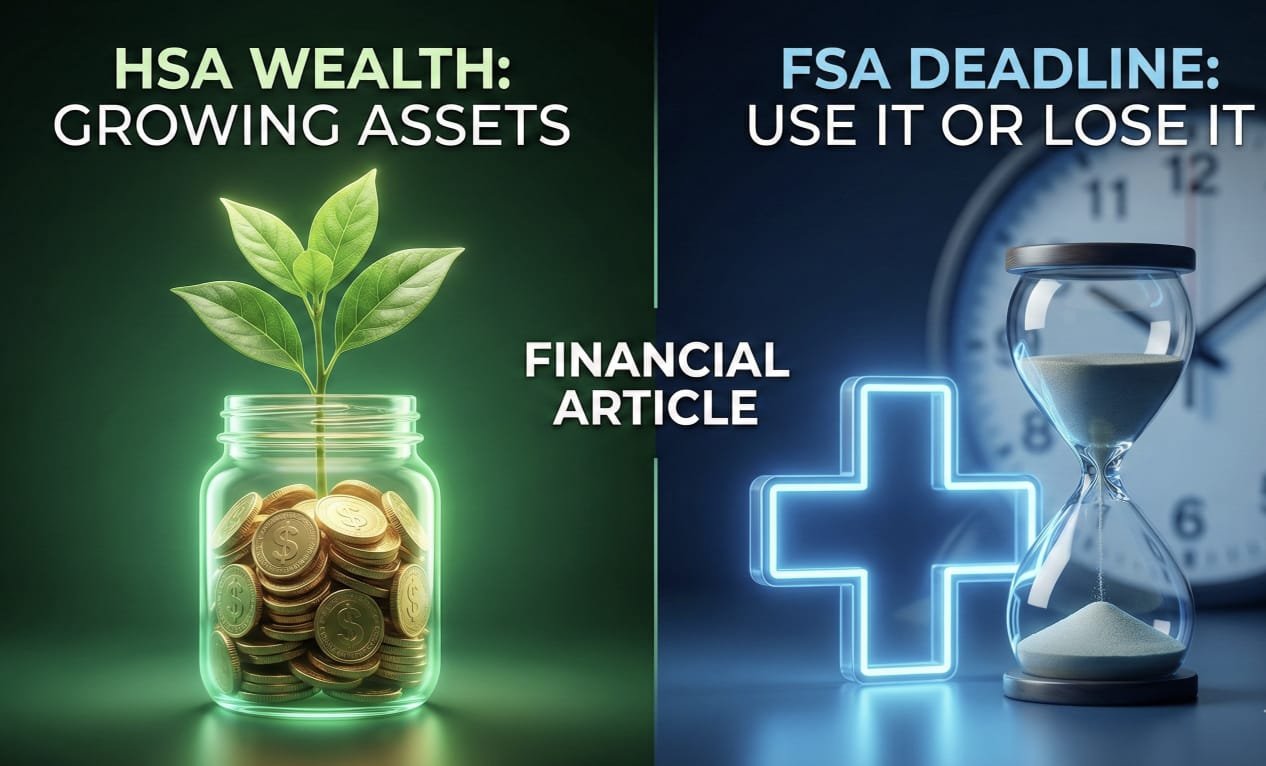
Imagine standing at the pharmacy counter. You’ve got a crying toddler on your hip, a prescription that costs way more than you expected, and a line of impatient people behind you. You reach for your wallet, hoping you grabbed the right card. Is it the FSA debit card? Did you put enough in the HSA this year? Or are you paying out of pocket—again?
I have seen this look of panic on my clients’ faces for over 15 years, but honestly, in 2026, that panic feels a little more intense. Healthcare costs in the US aren’t just rising; they are skyrocketing. The receipt you get at the pharmacy counter today looks very different from the one you got three years ago.
The anxiety is real. Is the money in your account enough to cover these new prices? Or are you about to dip into your emergency fund—again? But here is the good news amidst the stress: the IRS gives us two powerful tools to fight back.”
The problem? Most people don’t understand the difference between HSA vs FSA.
Every open enrollment season, I sit down with coffee and a stack of benefit packets, and I see smart, hardworking people leaving thousands of dollars on the table because they picked the wrong acronym. They treat these accounts like boring administrative paperwork rather than what they actually are: your first line of defense against medical inflation and, in one specific case, a secret weapon for building serious wealth.
If you are feeling stressed about rising costs or confused by the jargon in your HR handbook, take a deep breath. We are going to fix that right now.
Table of Contents
ToggleHSA vs FSA: The Core Differences You Need to Know
Let’s strip away the corporate speak. At their most basic level, both Health Savings Accounts (HSAs) and Flexible Spending Accounts (FSAs) are tax-advantaged buckets of money designed to pay for qualified medical expenses. That means you pay for braces, copays, and prescriptions with pre-tax dollars.
Why this is huge in 2026: If you are in a 24% tax bracket, paying a $100 bill with pre-tax money is like getting an instant 24% discount. That is a win regardless of which account you use. But that is where the similarities end. When comparing HSA vs FSA, think of it like this:”
HSA vs FSA: The Core Differences
Best for long-term wealth
- You Own It: Stays with you if you quit your job.
- No Expiration: Funds roll over forever.
- Investable: Grow money tax-free like a 401(k).
- Eligibility: Requires HDHP Plan.
Best for immediate spending
- Employer Owned: You lose it if you leave.
- Use-It-or-Lose-It: Funds expire yearly.
- No Investing: Cash account only.
- Eligibility: Works with most health plans.
The FSA (Flexible Spending Account) is like a gift card from your employer. It’s convenient, it’s loaded with cash upfront, but it has an expiration date. The account is technically owned by your employer. If you quit your job, you generally leave that money behind.
The HSA (Health Savings Account) is like a 401(k) for your health. You own it. Forever. It travels with you from job to job. The money goes in, it grows, and you decide when to spend it.
The "Ownership" Factor
This is the single biggest distinction my clients often miss, and in the gig-economy and shifting job market of 2026, it matters more than ever.
FSA: You are essentially ‘renting’ the account. The account technically belongs to your employer. If you quit your job, get laid off, or retire in 2026, you generally leave any unspent money behind. It is a painful parting gift to your boss.
HSA: You own the account. Period. It is like a 401(k) for your health. It travels with you from job to job. The money goes in, it grows, and you decide when to spend it—whether that is tomorrow or 20 years from now.”
Planner’s Tip: I once had a client, “Sarah,” who built up $2,000 in her FSA, intending to use it for LASIK surgery in December. She got laid off in November. Because the FSA is employer-owned, she lost access to those funds immediately (unless she elected COBRA). If that money had been in an HSA, it would have walked out the door with her.
The "Use It or Lose It" Rule: A Critical Comparison
This is the rule that causes the most anxiety—and the legendary “December spending spree” where people buy five pairs of prescription sunglasses just to burn off their balance.
The FSA Danger Zone
FSAs are famous for the ‘Use It or Lose It’ rule. This rule causes the most anxiety—and leads to the legendary ‘December spending spree’ where people buy five pairs of prescription sunglasses just to burn off their balance.
Generally, you must spend every penny in your account by the end of the plan year (usually December 31st). If you have $500 left over? Poof. Gone. Returned to your employer. In 2026, throwing away $500 is simply not an option for most families.
Note on the ‘Carryover’ Rule (2026 Update): Some employers offer a ‘grace period’ (2.5 months extra to spend) or a ‘carryover’. If your plan allows for a carryover, the IRS has increased the limit. For the 2026 plan year, you can likely roll over up to $680 of unused funds into 2027.
Warning: If you have $1,000 left, you can roll over the $680, but you will still lose the remaining $320. Check your specific company handbook immediately so you don’t get caught out.
The HSA Safety Net
HSAs have zero expiration dates. You could contribute $3,000 today and not spend a dime of it until you are 85 years old. The balance rolls over year after year, compounding and growing. This fundamental difference transforms the HSA vs FSA debate from a spending question into a saving question.
2025 Contribution Limits: HSA vs FSA Updates
To make the best decision, you need the hard numbers. The IRS adjusts these limits annually for inflation. For 2025, we are seeing some helpful increases that allow you to shelter more income from taxes.
Here is exactly how much you can stash away.
📈 2026 Contribution Limits
*Age 55+ Catch-up contribution for HSA remains $1,000 extra.
2026 Contribution Limits: HSA vs FSA Updates
| Account Type | Category | 2025 Limit | 2026 Limit | Change |
| HSA (Health Savings Account) | Self-Only Coverage | $4,300 | $4,400 | +$100 |
| HSA | Family Coverage | $8,550 | $8,750 | +$200 |
| HSA | Catch-Up (Age 55+) | $1,000 | $1,000 | No Change |
| FSA (Health Care) | Individual Contribution | $3,300 | $3,400 | +$100 |
| FSA (Health Care) | Max Carryover Amount | $660 | $680 | +$20 |
Why These Numbers Matter in 2026: You might look at a $100 or $200 increase and think, ‘Is that it?’ But let’s be real for a second. In an economy where the price of everything from groceries to prescriptions keeps climbing, every single tax-free dollar counts.
For a family, that extra $200 in your HSA isn’t just a number on a spreadsheet. That is partially covering a couple of unexpected urgent care visits or paying for a set of contact lenses tax-free. By maxing out these new 2026 limits, you are effectively shielding nearly $9,000 of your hard-earned income from the taxman. That is money staying in your pocket, building your financial fortress, rather than disappearing into taxes.
Understanding the Catch-Up
If you are age 55 or older, the HSA becomes even more potent. You can add an extra $1,000 “catch-up” contribution. Unlike 401(k)s where the catch-up age is 50, for HSAs it is strictly 55.
For a married couple both over 55 with family coverage, you can theoretically sock away $10,550 tax-free in 2025 (Family limit of $8,550 + two $1,000 catch-ups, though the second catch-up must go into a separate HSA account in the spouse’s name)
See More Article For
Which Account Builds More Wealth? (HSA vs FSA Investment Analysis)
This is where the magic happens. This is the section I want you to bookmark.
You cannot invest your FSA funds. It is a cash account, sitting there earning zero interest (usually), waiting to be spent. It is purely a transactional tool.
You CAN invest your HSA funds. Most HSAs allow you to invest your balance in mutual funds, ETFs, or stocks once you reach a certain minimum balance (often $1,000).
Think about that. If you max out your HSA for 2025 ($8,550) and invest it in the S&P 500, that money grows tax-free. If you don’t need it for medical bills this year, it stays invested. Over 10 or 20 years, an HSA can grow into a six-figure medical nest egg. In the battle of HSA vs FSA, the HSA is the only one that fights inflation.
Eligibility Rules for HSA vs FSA: Are You Qualified?
Before you get too excited about the HSA, we have to check if you are allowed to have one. The IRS has strict velvet ropes here.
The HDHP Requirement
Before you get too excited about the tax breaks, we have to check if you are actually allowed to have one. The IRS has strict velvet ropes here, and for 2026, the entry price has gone up slightly.
To open or contribute to an HSA in 2026, you must be enrolled in a High Deductible Health Plan (HDHP). Here is exactly what that means this year:
Minimum Deductible: Your plan must have a deductible of at least $1,700 for yourself (up from $1,650) or $3,400 for your family (up from $3,300).
Maximum Out-of-Pocket: This is your safety net. The most you should have to pay out-of-pocket (including deductibles and copays, but not premiums) cannot exceed $8,550 for self-only coverage or $17,100 for a family.
Warning: If your health plan has a low deductible (traditional PPO or HMO) or if your out-of-pocket max is lower than these numbers, the IRS generally says no to an HSA for you. You are disqualified from the ‘secret weapon’ account, but you can still likely use the FSA.”
The FSA Flexibility
The FSA is much easier to get into. You generally just need to be an employee of a company that offers one. You can pair an FSA with almost any health plan except an HSA (with one exception below).
Can You Have Both?
Usually, no. The IRS prohibits you from double-dipping. If you have a standard General Purpose FSA, you cannot contribute to an HSA.
The Loophole: Some employers offer a “Limited Purpose FSA” (LPFSA). This account can only be used for dental and vision expenses. If you have access to this, you can pair it with an HSA. This is a pro-level move: use the LPFSA for braces and glasses, and let your HSA grow untouched for retirement.
Real-Life Scenarios: Who Wins in HSA vs FSA?
Numbers on a page are fine, but let’s apply this to real life. I’ve created three personas based on people I’ve helped this year. See which one resonates with you.
1. The Young Single Professional ("Alex")
Profile: 28 years old, healthy, rarely sees a doctor.
Goal: Maximizing net worth.
The Verdict: HSA Wins by a Landslide.
Why: Alex qualifies for the cheaper premiums of the HDHP. By choosing the HSA, Alex can contribute the new max ($4,400 in 2026) and invest it. Since medical expenses are low, this account acts as a secondary retirement fund. The Math: If Alex puts that $4,400 into the S&P 500 instead of paying higher premiums, that single year’s contribution could grow significantly over 30 years.
Strategy: Treat the HSA deduction like a bill. Pay it, invest it, forget it.
2. The Growing Family ("The Millers")
Profile: Married, two kids (ages 4 and 7), one has asthma. Expecting regular pediatrician visits and prescriptions.
Goal: Cash flow management and predictability.
The Verdict: It’s Complicated (Lean FSA or HSA with Cash Reserves).
Why: The Millers might fear the high deductible of the HDHP. Let’s be honest: having to pay the first $3,400 of medical bills (the 2026 family minimum) out of your own pocket before insurance kicks in is scary. If they don’t have that cash sitting in a bank account, an HDHP/HSA combo can feel dangerous. In this case, a traditional plan with a Health FSA might offer a better ‘sleep-at-night’ factor.
However: If the Millers do have an emergency fund, switching to the HSA is still mathematically superior in the long run. Being able to shield $8,750 from taxes in 2026 is a massive win.
But here is the catch: If cash is tight right now, the FSA has a special superpower. It provides immediate access to the full $3,400 limit on Day 1 of the year (even if that money hasn’t been deducted from their paycheck yet). An HSA makes you wait until you deposit the cash; an FSA fronts you the money.”
3. The Near-Retiree ("Linda")
Profile: 58 years old, eyeing retirement in 7 years.
Goal: Reducing taxable income and preparing for future healthcare costs.
The Verdict: HSA is Critical.
- Why: Linda needs to leverage the Catch-Up Contribution. By maxing out her HSA now, she is building a tax-free fund to pay for Medicare premiums and long-term care insurance later.
- 2026 Super-Strategy: If Linda and her husband are both 55+, they can theoretically sock away $10,750 tax-free this year (Family Limit of $8,750 + two $1,000 catch-up contributions). That is a serious boost to their retirement nest egg right at the finish line.
The "Secret" Strategy: The Triple Tax Advantage
I promised you a wealth-building secret. In the financial planning world, the HSA is unique because it offers the Triple Tax Advantage. No other account—not your 401(k), not your Roth IRA—can claim this.
Tax-Free Contributions: Money goes in before taxes (lowering your taxable income today).
Tax-Free Growth: Interest and investment gains are never taxed.
Tax-Free Withdrawals: As long as you use the money for qualified medical expenses, you pay zero taxes on the way out.
The HSA Triple Tax Advantage
Tax-Free In
Contributions are deducted from your paycheck before taxes are taken out.
Tax-Free Growth
Invest your funds in stocks or funds. All earnings and interest grow with zero tax.
Tax-Free Out
Withdrawals for qualified medical expenses are 100% tax-free.
The “Shoebox” Strategy Here is the advanced maneuver I teach my wealthy clients: Don’t use your HSA debit card. When you go to the pharmacy, pay with your regular credit card (get those travel points!). Take the receipt, scan it, and save it in a digital folder (or a shoebox). Leave your money in the HSA invested in the market.
Ten years from now, you can reimburse yourself for that pharmacy bill you paid today. There is no time limit on reimbursement. You let your money grow tax-free for a decade, and then pull it out tax-free when you want the cash. It is the ultimate emergency fund.
Conclusion
Choosing between HSA vs FSA isn’t just about checking a box on a confusing HR form. It is about taking control of your financial health.
If you have a chronic condition, tight cash flow, and a low tolerance for surprise bills, the FSA and a traditional health plan are a safe, solid choice. There is no shame in choosing predictability.
But, if you can handle a higher deductible and have the discipline to save, the HSA is arguably the most powerful investment vehicle in the American tax code. It turns money that would have vanished into insurance premiums into an asset you own forever.
Your Next Step:
Check your spouse’s open enrollment options—coordinate so you aren’t doubling up on conflicting accounts.
If you choose the HSA for 2026, try to increase your contribution by just 1% over last year.
If you choose the FSA, set a calendar reminder for November 1st, 2026, to check your balance so you don’t lose those funds.
You work too hard for your money to let it get eaten up by taxes or forfeited to your employer. Choose wisely, and here’s to a healthy, wealthy 2026!
Frequently Asked Questions
It depends on your health and financial goals.
- The HSA is generally considered "better" for long-term wealth building because you own the account, funds never expire, and it offers a triple-tax advantage. In 2026, with the contribution limit raised to $4,400, it is even more powerful.
- The FSA is better if you have high medical costs but do not qualify for a High Deductible Health Plan (HDHP), or if you need access to the full year's funds immediately on Day 1.
The biggest difference between HSA vs FSA is ownership and portability.
- HSA: You own the account. If you leave your job, the money goes with you. Unused funds roll over year after year forever.
- FSA: The employer owns the account. If you quit, you usually lose the funds. Unused funds generally expire at the end of the year ("Use It or Lose It"), though in 2026 you can carry over up to $680 if your employer allows.
| Feature | HSA (Health Savings Account) | FSA (Flexible Spending Account) |
|---|---|---|
| Pros | Triple tax benefits; Investable growth; Never expires. | Full funds available Day 1; Works with standard PPO plans. |
| Cons | Requires High Deductible Plan (Deductible must be $1,700+ in 2026). | "Use it or Lose it" rule; Not portable if you quit. |
The consensus on personal finance forums like Reddit (e.g., r/personalfinance) overwhelmingly favors the HSA as an investment vehicle. Many users refer to the HSA as a "Super IRA" because of its tax-free growth potential.
However, users often recommend the FSA for specific planned expenses (like LASIK or braces) where you can use the employer's money upfront before it is deducted from your paycheck.
While HSA and FSA are accounts funded by you (and sometimes your employer), an HRA (Health Reimbursement Arrangement) is funded solely by your employer.
Key Distinction: You cannot contribute your own money to an HRA, and if you leave the company, the HRA money stays behind. Unlike the HSA, an HRA is not your personal asset.