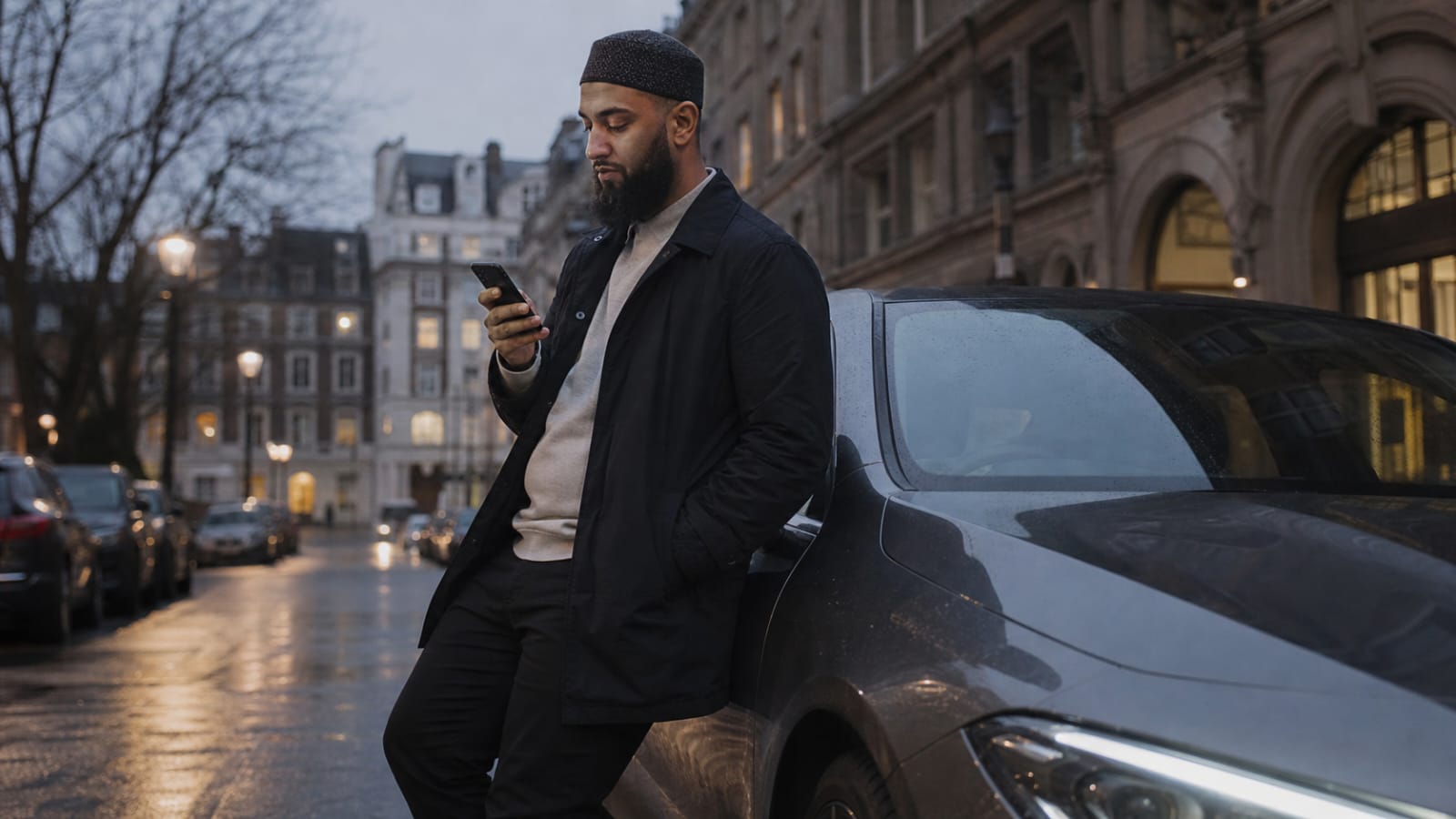
Owning a car in the UK brings up a specific dilemma for practising Muslims. By law, the Road Traffic Act 1988 makes motor insurance strictly mandatory. You simply cannot drive without it. However, standard commercial insurance heavily involves elements like interest (Riba) and excessive uncertainty (Gharar), which go directly against classical Islamic financial principles (Fiqh al-Muamalat).
This puts you in a tough position. You have a civic duty to follow the law of the land, but a religious obligation to avoid prohibited financial contracts. It leaves many in the community asking: how do we navigate this requirement without compromising our faith? Is there actually a Shariah-compliant option available today?
If you are looking for a straightforward answer about Halal Car insurance in UK, this guide covers exactly what you need to know. Without any confusion or fluff, we will explain why standard policies are problematic, how leading UK scholars apply the rule of necessity (Darurah), the reality of the current market, and the practical, Shariah-conscious steps you can take right now to responsibly insure your vehicle.
Table of Contents
ToggleWhy is Conventional Insurance Haram? (Breaking Down the Arabic Jargon)
First off, let’s clear up a massive myth. Islam is absolutely fine with protecting your wealth. In fact, protecting your property (Hifz al-Mal) is one of the main goals of Islamic law (Maqasid al-Shariah). The religion wants you to be safe and secure.
The problem is not the idea of insurance. The problem is the hidden mechanics of the contract you sign. Most Islamic scholars worldwide agree that standard commercial insurance is invalid (batil) because it contains three strictly banned elements: Riba, Gharar, and Maysir. Let’s break these down into plain English.
1. Riba (Interest and Usury)
When people hear “Riba,” they usually think of interest on a bank loan. But standard insurance triggers Riba in two ways:
Unequal Money Exchange (Riba al-Fadl): Imagine you pay £500 for a year of cover. A month later, your car is written off, and the company hands you £10,000. In Islamic law, swapping money for money in unequal amounts without trading a physical object is a form of unjust enrichment.
Funding the Interest System: Where do you think insurance companies keep the billions of pounds they collect in premiums? They don’t just stuff it under a mattress. By law, to stay solvent, they invest your premium money into government bonds and interest-bearing money markets. By buying a standard policy, you are directly paying into a system fuelled by interest.
2. Gharar (Excessive Uncertainty)
Think of Gharar like buying a mystery box. You hand over your hard-earned cash, but you have no idea what is inside. For an Islamic contract (Mu’awadah) to be valid, there must be absolute clarity. I give you £10, you give me a pizza. It is a clear, certain exchange.
With standard car insurance, you pay a fixed premium (say, £800). But what do you get in return? You only get a payout if you have an accident. If you drive perfectly all year, the company keeps your £800, and you get absolutely zero physical return. You paid for a “what if.” While peace of mind feels nice, Islamic law says a feeling is not a physical commodity you can buy and sell. This heavy imbalance makes the contract uncertain and speculative.
3. Maysir (Gambling and Speculation)
Because of the uncertainty we just talked about, insurance acts a lot like gambling (Maysir). It is basically a zero-sum game. You place a financial bet (your premium) against the statistical chance of a crash.
If you smash your car on day two, you “win” massively at the company’s expense. If you never crash, the company “wins” and pockets your cash without lifting a finger. One side’s win requires the other side’s loss, based entirely on a random future event. In classical Islamic law, this fits the exact definition of placing a bet.
Takaful Alternatives UK: How Halal Insurance Should Work
To solve this mess, Islamic economists created Takaful. The word simply means “shared responsibility” or “joint guarantee.” It first popped up as a modern business model in Sudan in 1979.
Takaful does not sell risk; it shares it. Instead of a buyer-seller setup, it is built on a charity contract (Tabarru). A group of drivers pool their money together as a donation. If one driver has a crash, the community pool pays for the repair.
Here is a simple breakdown of how Takaful differs from standard cover:
| Feature | Standard Car Insurance | Shariah-Compliant (Takaful) |
|---|---|---|
| The Contract | You buy risk transfer (Mu'awadah). | You make a charitable donation to a pool (Tabarru). |
| Who Owns the Money? | The insurance company's shareholders. | The drivers (participants) jointly own the pool. |
| Company's Job | They take the risk and keep the profits. | They act as a manager (Wakil or Mudarib) for a set fee. |
| Investment Rules | Money is put into interest-bearing bonds. | Money only goes into Halal assets (no alcohol, no gambling, no interest). |
| Leftover Cash? | Extra profit goes to wealthy shareholders. | Leftover money in the pool is given back to the drivers as a discount! |
The Takaful system is brilliant, fair, and entirely ethical. So, why can’t you just jump online and buy one in Britain? Well, that leads us to a painful history lesson.
The Ugly Truth: Why is there no Halal Car insurance in UK today?
The UK is the biggest hub for Islamic finance outside the Muslim world. We have Islamic mortgages, Halal bank accounts, and massive commercial Shariah investments. Yet, in 2026, there is zero fully Shariah-compliant retail motor insurance for standard drivers.
Why? Because of the ghost of Salaam Halal Insurance.
Back in July 2008, a company called Principle Insurance Holdings launched Salaam Halal. It was heavily celebrated. Backed by £60 million from rich Gulf Cooperation Council (GCC) investors and approved by the Financial Services Authority (FSA), it was meant to change the game. But by November 2009—just 16 months later—it completely collapsed and shut its doors to new customers.
The autopsy of Salaam Halal reveals a total disaster:
Terrible Pricing: To beat the massive UK price-comparison websites, Salaam priced their premiums way too low. Bad drivers bought the cheap policies, crashed, and the claims destroyed the company’s funds.
No Backup Plan: Normally, insurers use reinsurers to share massive losses. But the Islamic reinsurance market (Re-Takaful) barely existed back then. Salaam took all the hits alone.
The Muslim Consumer Truth: The company expected Muslims to happily pay a bit more for a Halal label. The harsh reality? Most young British Muslims cared more about getting the absolute cheapest price than following Shariah rules.
Bad Timing: CEO Bradley Brandon-Cross needed £80 million to survive but only raised £60 million. Launching right in the middle of the 2008 global financial crash meant when the money ran out, the Gulf investors refused to send more.
The Chilling Effect Today
Salaam’s failure terrified investors. Today, the regulators (the FCA and PRA) use strict “Solvency II” rules. If you want to start a Takaful company, you need to prove you have a mountain of cash locked away just in case things go wrong. Building separate Shariah boards and separate IT systems costs an absolute fortune.
Even highly successful Islamic fintechs won’t touch it. Look at Ayan Capital, a brilliant UK company offering Halal car finance using the Ijara wa Iqtina (lease-to-own) model. They admit that the insurance market is so toxic and heavily regulated that they cannot offer Halal car insurance alongside their car loans. Their customers are forced to go back out to the standard market to insure their Halal-financed cars.
Add to this the fact that consumer groups like Which? launched a massive super-complaint in 2025 against the whole car insurance industry for dodgy pricing and bad claims handling. No sensible investor wants to enter this chaotic market right now.
The UK Legal Mandate & The Rule of 'Darurah' (Necessity)
Since you cannot buy a Halal policy, you are stuck. You must follow the law, but you must follow your faith. This is where Islamic jurisprudence (Usul al-Fiqh) steps in to save the day through two concepts: Darurah (dire necessity) and Hajah (severe need).
Darurah is a life-or-death rule. It means your life, religion, sanity, family, or property is in immediate danger of destruction. The golden Islamic rule states: “Necessities render the prohibited permissible” (Al-daruratu tubihu al-mahzurat). Hajah is a step below that. It means you aren’t going to die, but you will suffer massive hardship, stress, and societal paralysis (mafsadah) if a rule isn’t temporarily lifted to give you a benefit (maslahah).
Some strict scholars argue driving isn’t a necessity. They say if you live in London, just take the bus or the Tube. But mainstream scholars look at reality. They say it is not about the necessity of driving, but the compulsion of state law.
If you drive without insurance, you become a criminal. Your car (your property) is seized, and you could lose your freedom. Scholars use the “jurisprudence of balancing” (Fiqh al-Muwazanah) and agree that losing your livelihood and freedom is a massive harm. Therefore, the state forces you into a situation of Darurah or Hajah.
The Catch: This permission comes with strict limits. The law also says: “Necessity is measured exactly according to its proportion” (Al-daruratu tuqaddaru bi qadariha). You are only allowed to break the rule just enough to stay out of trouble with the police. You cannot go wild.
What Do the UK Scholars Say? (The Fatwa Breakdown)
Because Muslims are forced into standard insurance, scholars have debated the issue endlessly. Here is exactly what the top minds say about finding Halal Car insurance in UK.
1. The Strict View (Al Qalam Shari’ah Panel)
The Al Qalam panel is a highly respected group of UK scholars. Their stance is rigid: standard insurance is 100% Haram because of Riba and Gharar. You are only allowed to buy it because a Halal alternative does not exist and the UK law forces you to. It is an emergency waiver, nothing more. You must spend the absolute minimum required to keep the police happy.
2. The Global View (Mufti Taqi Usmani)
Mufti Taqi Usmani, a global heavyweight in Islamic finance and former Supreme Court judge in Pakistan, agrees. He says standard insurance is straight-up gambling (Qimar). He rejects the idea that clever maths makes it okay. However, he admits Western Muslims are trapped by the law. He allows the purchase out of compulsion but urges the community to build Waqf (endowment) alternatives immediately.
Similarly, Mufti Faraz Adam (CEO of Amanah Advisors) says buying standard cover to protect a Halal-financed car is a necessary, ring-fenced compromise. It is a necessary evil to make Islamic finance work in Britain, not an ideal situation.
3. The Progressive Minority View (Islamic Finance Guru & Sh. Al-Zarqa)
There is a fascinating minority view championed by the late Sheikh Mustafa Al-Zarqa and scholars like Sh. Ali AlKhafeef and Nejatullah Siddiqi. Today, the popular UK platform Islamic Finance Guru (IFG) explores this angle.
They argue that modern insurance is not a gamble. Why? Because of the “Law of Large Numbers.” When a company insures a million drivers, they know exactly how many will crash using advanced statistics. For the company, there is zero uncertainty. Therefore, the Gharar vanishes. IFG points out that the goal of insurance—risk mitigation—is totally Halal. They also note that modern Takaful companies operate so similarly to standard ones (charging fees, aiming for surplus) that the line is blurry. While orthodox scholars hate this view, it brings comfort to many working professionals.
Third-Party vs. Fully Comprehensive: Which Should You Buy?
This brings us to the biggest debate in British Islamic finance: What type of cover should you buy?
The Strict Approach: Third-Party Only (TPO)
If you follow the strict Darurah (necessity) rule, you must only buy Third-Party Only cover. Why? Because the Road Traffic Act 1988 only legally demands you protect other people on the road. The law does not force you to protect your own car.
Since you are only allowed to interact with a Haram contract to fulfill the state’s minimum legal demand, upgrading to Fully Comprehensive to protect your own bumper crosses the line. According to this view, true reliance on Allah (Tawakkul) means accepting the financial risk to your own property rather than signing a dodgy contract for personal gain.
The Pragmatic Approach: Fully Comprehensive
Most British Muslims actually buy Fully Comprehensive, and they have two very smart reasons for doing so:
The Price Anomaly: The UK insurance market is crazy. Very often, Fully Comprehensive is actually cheaper than Third-Party Only. This is because insurance algorithms know that high-risk, reckless drivers tend to search for TPO. If your goal is to minimize the amount of cash you give to a Riba-based system, buying the cheapest option makes total sense. Forcing yourself to pay £300 more for TPO just to be “strict” causes unnecessary financial harm.
2. Asset Protection & Leasing: If you agree with the minority view (that risk mitigation is Halal), protecting your asset from total loss is simply smart wealth preservation (Hifz al-Mal). Furthermore, if you are planning to buy a vehicle through an Islamic company using our recommended halal car finance UK options, their Shariah-compliant lease contracts strictly force you to buy Fully Comprehensive cover to protect their investment. In that case, the comprehensive cover becomes a derived necessity.
How to Purify Your Halal Car insurance in UK (Workarounds)
Until a proper Islamic auto cover launches, you have to use the standard market. But you can do it smartly. Here are highly actionable steps to purify your policy.
1. Dodge the APR Trap (The 0% Credit Card Trick)
UK insurers love to offer “easy monthly payments.” Do not fall for it. They treat this like a formal credit agreement and slap a massive Annual Percentage Rate (APR) on top. Paying interest on deferred payments is clear-cut Riba.
The Al Qalam panel states you must pay your premium in one annual lump sum to avoid this interest entirely. But let’s be real—dropping £1,500 in one go is tough.
The Fix: Get an introductory 0% interest purchase credit card. Use the credit card to pay the insurer the yearly lump sum upfront. Then, pay off the credit card manually each month before the 0% promotion ends. You dodge the insurer’s interest, and you dodge the bank’s interest. It is a perfectly Halal workaround. (Note: If you genuinely cannot get credit and cannot afford the lump sum, scholars permit monthly payments under extreme necessity, but you must never miss a payment to avoid late fees).
2. Purifying Total Loss Payouts
If you have a massive smash and your car is a “total loss” (written off), the company will give you a cash payout. Can you keep money from a forbidden contract?
Yes, but only the exact fair market value of the car before the crash. Jurists view this as the insurer forcibly buying your broken car from you. However, if they overpay you by mistake or due to a weird policy clause, you cannot keep the extra cash. That excess is considered unjust enrichment. You must give the extra money away to charity (Sadaqah)—like poverty relief—without expecting any spiritual reward from God. It is purely a mechanical flush of dirty money.
3. Mutuals and Ethical Insurers
Look for “mutual” insurers. Standard companies are PLCs, meaning they milk you for profit to pay their wealthy shareholders. Mutual insurers are actually owned by the policyholders (you). They use leftover cash to lower next year’s premium, which acts a lot like the Islamic Tabarru (donation) model. Also, look for green/ethical insurers that publicly refuse to invest their premium pots into weapons, tobacco, or fossil fuels. It is not perfect Takaful, but it is a massive step in the right direction.
4. NCDs, Courtesy Cars, and Named Drivers
No Claims Discount (NCD): Totally Halal. It is just a vendor discount based on your safe driving record. You can use it and transfer it.
Courtesy Cars & Legal Cover: Halal. Think of a replacement car as a logistical service (Ijarah) rather than a financial bet.
Named Drivers (No Fronting!): Adding yourself to your mum’s policy to drive legally is fine. But “fronting”—lying to the insurer and saying your mum is the main driver when you actually drive the car every day to get a cheaper price—is fraud (Ghash). Fraud is categorically Haram, regardless of the whole insurance debate.
Future Outlook: Will We Ever Get Proper Takaful?
There is light at the end of the tunnel. The global Takaful market is booming, expected to hit $81 billion by 2034. UK entrepreneurs are desperate to bring that success home.
The biggest hope right now is Takaful Ltd, a new project led by Mohamed Harrath, the CEO of the Islam Channel. They are in late-stage development right now, crunching massive amounts of data on British Muslims to build accurate pricing models. They are sitting down with the Bank of England and the FCA to get the green light. If all goes well, we might finally see a launch in 2026 or 2027. But they have to learn from the 2008 Salaam Halal disaster: they need massive cash reserves and solid Re-Takaful backing so they don’t go bust after a few big crashes.
Additionally, the UK government is tweaking the rules. The FCA and PRA are creating new frameworks for “captive insurance” by 2027 and updating Solvency II rules. Combined with the rise of “InsurTech” (using Open Banking APIs and AI to cut admin costs), a lean, cheap, digital-first Halal car insurance provider is closer to reality than ever before.
Conclusion
Let’s wrap this up. The hunt for Halal Car insurance in UK is currently a painful compromise. Because standard insurance is riddled with Riba, Gharar, and Maysir, it violates Islamic law. But because you live in Britain and the state legally forces you to have cover to drive, you are granted a temporary theological pass through the rule of necessity (Darurah).
Do not let the guilt eat you up. You are doing your best in a flawed system. As the broader UK Islamic finance sector rapidly matures—evidenced by the increasing availability of Shariah-compliant halal mortgage UK options and Islamic FinTech—the insurance market will eventually have to catch up. Until projects like Takaful Ltd finally break through the regulatory red tape, you have to play the game smartly.
Drive safe, protect your wealth, and let’s hope the UK market finally steps up to give British Muslims the ethical cover they deserve.
Frequently Asked Questions
Is it Haram to pay my car insurance monthly?
The Solution: Pay the annual lump sum upfront. If you cannot afford it, use a 0% purchase credit card to pay the yearly total, then pay off the card monthly before the 0% period ends. Only accept a monthly plan directly from the insurer if you are in extreme financial hardship and have absolutely no other choice (under the rule of Darurah).