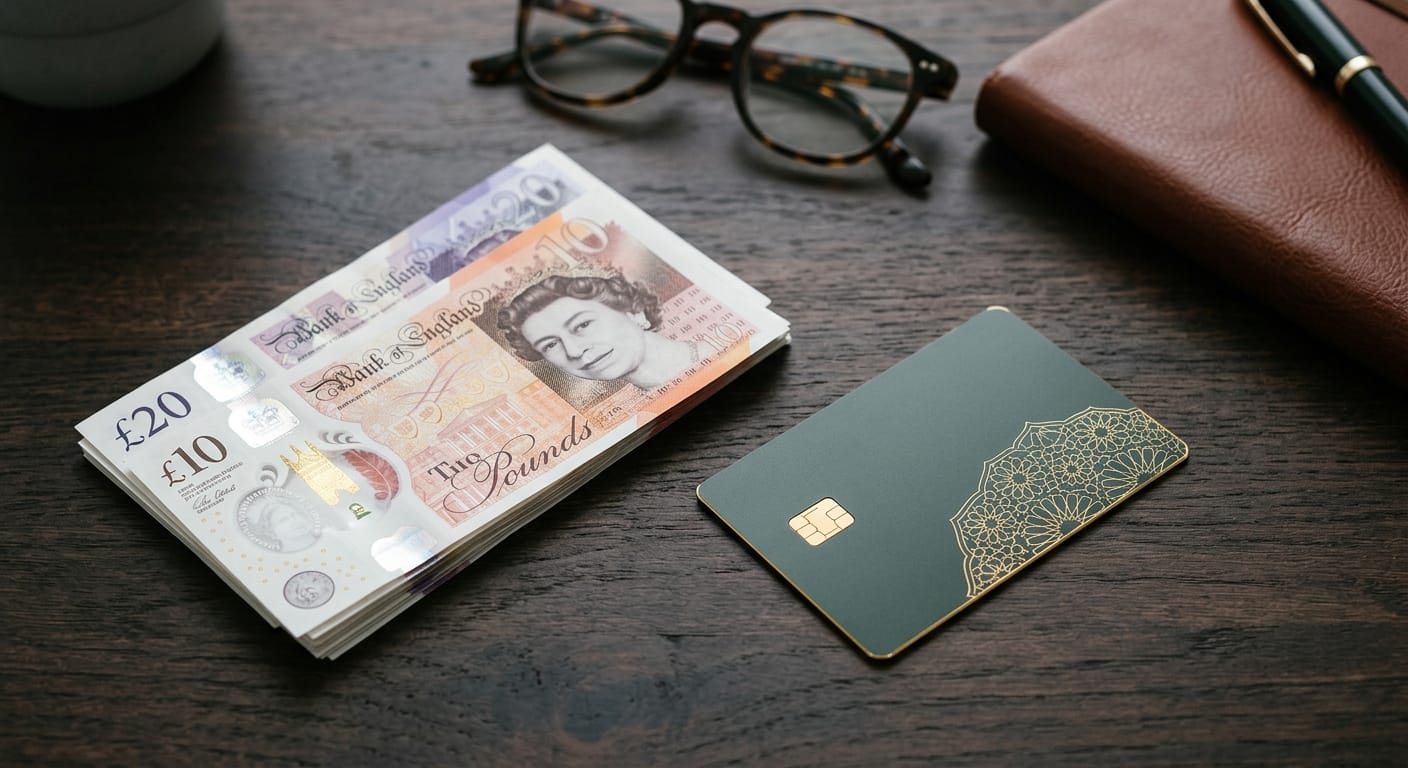
Finding a truly Halal credit card in the UK is one of the biggest financial hurdles for British Muslims today.
While the UK stands as a global pioneer in corporate Islamic finance—boasting a £5.9 billion Sharia banking market, launching sovereign Sukuks, and even establishing Alternative Liquidity Facilities via the Bank of England—everyday retail banking tells a very different story.
When you need a simple piece of plastic to book a flight, get consumer protection for a large purchase, or build your credit score for a future mortgage, the Sharia-compliant options suddenly seem to vanish. You are left with a frustrating choice: miss out on vital financial tools or compromise your faith.
But it doesn’t have to be this way.
In this comprehensive guide, we cut through the confusion. We will break down the harsh realities of the UK lending market, explain the Islamic rulings (Fiqh) regarding credit in plain English, uncover the truth behind the “0% interest” trap, and reveal the practical fintech alternatives you can use right now to build a pristine credit score entirely interest-free.
Table of Contents
ToggleThe Harsh Reality: Do Halal Credit Cards in the UK Actually Exist?
Let’s cut straight to the chase and answer the most common question: Does a 100%, universally scholars-approved, standard unsecured halal credit card exist from a major UK bank today?
The answer is no. To understand why this is missing, we need to look at three massive roadblocks: how Islamic finance works, strict UK laws, and the crazy cost of starting a bank.
First, standard credit cards run on a system of fractional reserve lending and revolving debt. In simple English: they make their profit just by lending you money. Islamic finance says a big “no” to this. Islam requires risk-sharing and asset-backed trading. You cannot make money simply by renting out money.
Now, overseas in places like Malaysia, the UAE, or Saudi Arabia, banks have created Sharia-compliant credit cards. They use complex structures like Ujrah (charging a fixed fee for a service) or Tawarruq. Tawarruq basically means the bank buys a physical commodity (like metal) on your behalf, sells it immediately for cash, and gives you that cash. But here’s the problem: stricter Islamic scholars absolutely hate Tawarruq. They see it as a sneaky, synthetic loophole that violates the spirit of Sharia. Because of this controversy, it hasn’t caught on with retail banks in the UK.
The Problem with UK Law (The CCA 1974)
Even if a bank wanted to launch a perfectly halal card, the UK government accidentally makes it incredibly hard.
Any consumer lending in the UK is governed by an old law called the Consumer Credit Act 1974 (CCA), which controls a £200 billion lending market. This law is obsessed with the word “interest.” It legally forces banks to use statutory language like “Annual Percentage Rate (APR),” “default sums,” and “early settlement rebates.”
Imagine an Islamic bank creates a beautiful, halal product based on shared ownership or a fixed admin fee. The law still forces them to advertise it with an “APR.” The moment a Muslim sees “APR,” they instantly think of Riba (interest) and run a mile. If the bank tries to explain it differently, the financial regulators (the FCA) might accuse them of mis-selling or breaking the rules.
There is also a rule in the CCA (Section 66A) called the Right of Withdrawal. It says a borrower can cancel a credit agreement and just pay back the borrowed money plus interest. But in Islamic finance, if you do a Murabaha (a halal buy-and-sell contract), the sale is done. You own the asset. Unwinding a physical sale just because a UK statute says you can creates a legal and theological nightmare.
The Cost of Compliance
On top of this, proving that money is clean (Anti-Money Laundering) is much harder for Islamic banks. Because halal finance uses multi-step contracts and asset trading to avoid interest, regulators get suspicious. It looks complex to them, so they force Islamic banks to spend millions on heavy compliance frameworks.
Finally, starting a credit card company in the UK requires about £30 million in “patient capital” just to absorb early losses and underwrite risk. No single Islamic fintech startup has that kind of cash to risk on unsecured credit. So, the big Islamic banks logically stick to safe, profitable things like Islamic mortgages (Home Purchase Plans) and commercial property.
The Fiqh: Why Your Standard Plastic is a Problem (Even if you pay it off!)
You might be thinking, “Look, I know how standard credit cards work. But what if I just get a normal card and pay it off in full every single month so I never get charged a penny of interest?”
It’s a smart thought, but we need to look at Islamic jurisprudence (Fiqh) to understand why orthodox scholars still say this is strictly forbidden. It is not just about the word “interest”; it is about the actual contract you are signing.
The main issue is Riba al-Nasiah (charging interest on a delayed payment). The Quran (Surah al-Baqarah, verses 275–281) strictly prohibits this. A standard credit card contract explicitly states that if you don’t pay within the grace period, they will charge you extra based on how much time has passed. That is textbook Riba.
The Hidden Late Payment Trap
But what if you are disciplined? What if you never miss a payment?
Here is the kicker: the late payment fee penalty clause. Under classical Islamic commercial law, you cannot sign a contract that includes a conditional penalty for delaying a debt payment. Even if you are a millionaire and pay it off daily, the sheer act of signing a piece of paper that says, “I agree to pay Riba if I mess up,” is seen by most orthodox scholars as an agreement to do something haram.
The International Islamic Fiqh Academy issued a very clear ruling (Resolution No. 108/12/2). They stated unconditionally that it is impermissible to use a credit card if there is an interest clause attached, even if you are absolutely determined to pay it off on time. The contract itself is broken from an Islamic perspective.
Cash Advances and Debt Selling
There are other hidden traps, too. If you put your conventional credit card into an ATM and withdraw £100, the bank immediately charges you a cash advance fee plus instant interest. In Islam, trading fiat money for fiat money must be done on the spot, equally. Charging a premium to hand over cash is literally selling money for more money. That is absolute Riba.
Furthermore, conventional banks sell your debt. If people miss payments, banks bundle those debts and sell them to collection agencies at a discount. Selling debt for less than its face value (Bay’ al-Dali bi al-Dali) is strictly forbidden in Islam.
Why are we stuck in this mess? Prominent scholars like Shaykh Yusuf DeLorenzo remind us of our history. Before World War II, the Islamic world had brilliant, fair, zero-interest business and trade systems. Colonialism systematically dismantled these, replacing them with Western, interest-based banks. Today, as UK Muslims, we are dealing with the fallout of that history, trying to rent houses and buy cars in a system built on rules we don’t agree with.
The Ultimate Debate: The "0% Interest" Halal Credit Card UK Dilemma
Despite the strict rulings from orthodox academies, there is a massive, intense debate happening right now in the UK Muslim community. Many Muslims use “0% interest” purchase credit cards. Why? Because they need the consumer protection, they need to build their credit score, or they just need help spreading out the cost of a big purchase.
Some modern advisory platforms, like Islamic Finance Guru (IFG), and specific global scholars (like Professor Monzer Kahf, Shaykh Faraz Rabbani, and Mufti Taqi Usmani—a founding architect of AAOIFI standards) take a pragmatic view.
Their argument is simple: The act of borrowing money is not haram, as long as you don’t actually pay any premium (interest) on top of it. IFG allows the use of credit cards under strict conditions. They justify it with four main points:
Borrowing money interest-free is totally halal.
We live in the West. Almost every contract (electricity, water, broadband) has a late-payment penalty clause hidden in the terms. If we avoided every hypothetical penalty clause, we couldn’t live modern life.
Credit cards offer vital benefits like fraud protection and cash flow help.
The card companies make most of their money from the fees they charge the shops (merchant interchange fees), not just from interest, so their income isn’t 100% haram.
Mufti Taqi Usmani even issued a fatwa saying it is permissible to use a credit card if you set up an automatic direct debit to clear the full balance every month, mathematically guaranteeing you never pay a penny of Riba.
The Dark Side of the 0% Trap
But here is where you need to be incredibly careful. The “0% interest” label is heavily regulated by UK law and hides some scary traps.
By law (FCA and the CCA), even if a bank offers you 0% interest for 24 months, they must advertise a “Representative APR” on the poster. For example, it might say “24.9% variable.” You are legally signing an interest-bearing agreement, even if the interest is paused for two years.
Worse, “Representative APR” means the bank only has to give that 0% deal to 51% of the people they accept. If your credit score is slightly low, you might be in the 49% who secretly get offered a much higher rate.
Let’s look at a real-life hypothetical trap: Imagine Brother Tariq uses a 0% credit card to buy a £2,000 laptop for his graphic design business. He plans to pay it off over 12 months. Three months in, Tariq unfortunately loses his job and misses just one minimum payment.
What happens? The bank instantly cancels his 0% promotional offer. They immediately slap a retroactive 24.9% compounding interest rate across his entire balance. In the blink of an eye, Tariq is drowning in a Riba-based debt cycle that is terrifyingly hard to escape.
Section 75 vs. Chargeback: The Protection Trade-Off
So why risk it? The biggest reason Muslims still use these conventional cards is Section 75 of the Consumer Credit Act 1974.
This is an incredibly powerful UK law. It says that if you buy something between £100 and £30,000 using a credit card, the credit card company is equally legally responsible as the shop. If you buy £2,000 flights and the airline goes bankrupt, the credit card company legally has to refund you.
When trying to find Islamic alternatives (like using a halal debit card), you lose Section 75. Instead, you have to rely on a voluntary scheme called “Chargeback.”
Here is a simple breakdown of the difference:
| Feature Comparison | Section 75 (Conventional Credit Cards) | Chargeback (Islamic Debit & Prepaid Cards) |
|---|---|---|
| Legal Framework | Legally binding UK statute (Consumer Credit Act 1974). | Voluntary administrative scheme by Visa/Mastercard. |
| Minimum Spend | £100. | No minimum spend. |
| Maximum Spend | £30,000. | No maximum limit. |
| Liability Entity | The credit card issuer is jointly liable with the merchant. You can sue the card company. | Your bank politely asks the retailer's bank for the money back. |
| Time Limit | Up to 6 years (standard statute of limitations). | Usually a strict 120-day limit from the purchase date. |
| Geography | Applies globally. UK bank is liable even if the shop is in China. | Subject to network rules. Overseas shops can ignore it. |
Chargeback is great for everyday fraud, but for big purchases, losing Section 75 is a massive trade-off you need to weigh carefully.
Real Islamic Alternatives: Sharia-Compliant Finance Apps
Since a traditional halal credit card doesn’t exist, brilliant Muslim minds in the UK fintech sector have built amazing workarounds. These apps give you the digital convenience of a credit card without the Riba.
1. Algbra: Algbra is fantastic. It is an FCA-regulated Electronic Money Institution (EMI). You get a zero-fee account and a Mastercard debit card. Their strict ethics policy guarantees your money is “ring-fenced” (kept safe) and is never invested in haram industries like gambling, arms, or fossil fuels. The best part? They charge zero fees for spending money abroad, which perfectly mimics the perks of premium travel credit cards. They even have live carbon-tracking so you can see your environmental footprint. The catch: Because they are an EMI and not a full bank, they don’t have the standard £85,000 FSCS protection, but your money is fully safeguarded at the Bank of England. It is currently GBP only and doesn’t allow overdrafts.
2. Kestrl: Kestrl took a different route. Instead of holding your money, it acts as an “overlay” for your current bank account using Open Banking APIs. It is packed with faith-aligned tools like automated Zakat calculators, Shariah investment screening, and an AI-driven “Mufti” chatbot for financial guidance. Their biggest game-changer is their alternative credit scoring system. Instead of judging you based on debt, Kestrl looks at your real-time spending habits and income stability. This is huge—so huge that Dubai’s Emirates Islamic Bank recently integrated Kestrl’s tech into their app!
3. Rizq & High-Net-Worth Options: Rizq is an upcoming digital challenger bank (currently on a waitlist) designed to merge daily spending with halal investing, ensuring your deposits aren’t secretly funding conventional loans in the background. If you are a high-net-worth individual with serious cash, places like Nedbank Private Wealth and Standard Chartered Saadiq offer exclusive Sharia-compliant charge cards and global wealth management in multiple currencies.
How to Build Your Credit Score Cleanly for an Islamic Mortgage
Here is the biggest stress for young Muslims: In the UK, your credit score dictates your life. You need a solid credit profile if you ever plan to finance a car the halal way in the UK, rent a nice flat, get certain finance jobs, and most importantly, get approved for an Islamic Home Purchase Plan.
In fact, if buying a house is your ultimate goal, understanding how a halal mortgage in the UK works is your crucial first step. But to get approved for any of these life-changing steps by lenders like Offa, StrideUp, or Gatehouse Bank, you must have a pristine credit score first.
The old advice was “just get a credit card to build credit.” We now know that’s problematic. Thankfully, open banking has created 100% halal ways to build a perfect credit score without going into debt.
Here are the best tools available today:
1. Rent Reporting via Open Banking (CreditLadder & Canopy)
For decades, paying a mortgage built your credit, but paying rent did nothing. That was completely unfair. Now, platforms like CreditLadder, Canopy, and Esusu fix this. You connect CreditLadder (an FCA-regulated institute) to your bank account. It spots your monthly rent payment and reports it directly to Experian, Equifax, and TransUnion. Since rent is an existing liability and not a debt, reporting it is 100% Halal. You can report to one agency for free, or pay £5-£8 a month to report to all three (highly recommended, as Islamic banks check different agencies). They’ve already reported over £2 billion in rent!
2. Experian Boost
This is totally free and straight from the credit bureau itself. Connect your bank account to Experian Boost, and it scans for regular, on-time payments of daily bills—like your council tax, water, gas, electricity, and even your Netflix or Spotify subscriptions. It instantly boosts your FICO score without you needing to borrow a single penny.
3. LOQBOX (The IFG-Certified Solution)
If your credit score is completely broken or invisible, LOQBOX is a miracle worker. It has been rigorously reviewed and certified as Sharia-compliant by Islamic Finance Guru. Here is how it works: You commit to saving between £20 and £200 a month for a year. Behind the scenes, LOQBOX’s partner (DDC Financial Solutions) locks a 0% APR loan equal to your goal (e.g., £1,200) into a digital vault. Every month you “save” your money, LOQBOX reports it to the credit agencies as a perfect, on-time loan repayment.
After 12 months, your credit score skyrockets, and you get all your saved money back. The caveat: To get your money back for free at the end, they ask you to open a new conventional bank account (like NatWest). IFG warns that you must ensure this new account doesn’t accrue interest, or you must give away any interest earned to charity (tathir/purification). Alternatively, you can just pay a £30 “Flexi-Unlock” fee to get your cash sent to your current account. IFG considers £30 a perfectly fine admin fee for fixing your credit score cleanly.
| Halal Credit Building Tool | How it Works | Which Agencies it Boosts | Sharia Compliance Note |
|---|---|---|---|
| CreditLadder / Canopy | Reports monthly rent payments. | Experian, Equifax, TransUnion | 100% Halal. Uses existing rent, not debt. |
| Experian Boost | Scans bank for utility/streaming bills. | Experian Only | 100% Halal. No borrowing involved. |
| LOQBOX | Locks a 0% loan; you pay in monthly savings. | Experian, Equifax, TransUnion | IFG Certified. Pay £30 to unlock, or purify the bank interest. |
| Electoral Roll | Registering to vote proves your address stability. | All Agencies | 100% Halal admin action. Boosts score massively. |
The Future: Controversies & the Massive 2026 Reforms
The UK Islamic finance scene is moving at lightning speed. Some of it is controversial, but the future is incredibly bright.
The Score Mastercard Controversy
Recently, DND Finance and CEO Bill Dost launched the “Score Mastercard,” boldly calling it the UK’s first Shariah-certified credit card (certified by Shariah Experts and running on the Railsr platform). It is aimed at immigrants and those with poor credit.
However, the Muslim community pushed back hard. If you check forums like Reddit’s r/IslamicFinance or r/MuslimLounge, people are furious. Here is why: It is a secured credit card, meaning you have to put down your own cash as a deposit to get a credit limit. While they claim 0% interest, they charge a massive £120 access fee and a heavy £19.99 monthly maintenance fee.
To make matters worse, because of the rigid CCA laws we mentioned earlier, the card is legally forced to advertise a massive 29.99% Representative APR! Many Muslims view this as “Islamic window-dressing”—claiming to be halal while charging exorbitant fees that perfectly mimic predatory, subprime interest loans.
AI Wealth Management: Vault22
Looking ahead, the tech is getting mind-blowing. Standard Chartered’s venture arm is backing a platform called Vault22 and its upcoming AI system, Hafiq. It uses AI to monitor 12,000 global stocks in real-time. If a halal tech company suddenly buys a gambling subsidiary, the AI flags it instantly. It even uses automated purification (tathir) to instantly strip out any haram dividends from your portfolio, keeping you 100% compliant with AAOIFI standards 24/7.
StrideUp's Massive Milestone
On the property side, fintech lender StrideUp just made history. They launched the first public securitization of Shariah-compliant home purchase assets since 2018, issuing a massive £300 million Residential Mortgage-Backed Security (RMBS) called Meridian Funding 2025-1. Using the highly specialized ISDA/IIFM Tahawwut Master Agreement, they proved that Islamic real estate assets can be traded safely on global markets without violating Sharia debt-trading laws. This guarantees that halal mortgages in the UK will remain secure and competitively priced.
2026: The Year Everything Changes (CCA Reform & Student Loans)
Hold onto your hats, because the UK government is finally listening. HM Treasury is currently undergoing a massive modernization of the 1974 Consumer Credit Act. By 2026, they plan to move these rigid, outdated laws into the more flexible FCA Handbook.
The explicit goal of this reform is to remove the barriers blocking Islamic Finance and Green Finance. If they finally remove the legal requirement to plaster “APR” and “interest” terminology on profit-sharing contracts, a major digital bank will finally have the legal cover to launch a true, 100% Sharia-compliant retail credit card in the UK.
Also coming in the 2026-2027 academic year is the Lifelong Learning Entitlement (LLE). The government, guided by the Islamic Finance Council UK (UKIFC), is introducing Alternative Student Finance using a Takaful (co-operative fund) structure. This is a massive relief for families who constantly worry about whether student finance is haram in the UK, as Muslim students will finally be able to go to university without relying on traditional, interest-bearing loans!
Conclusion: Your Next Steps
The journey to find halal credit cards in the UK shows how hard it is to stick to our core ethical beliefs while navigating a capitalist system built entirely on interest. A perfect, high-street halal credit card doesn’t exist yet, and the 0% interest loophole is fraught with theological debate and hidden financial traps.
But you are not powerless. You don’t have to compromise your faith to survive in the UK.
Right now, you can use the incredible technology of open banking. Sign up for CreditLadder to report your rent. Connect Experian Boost to scan your Netflix bills. Use LOQBOX to physically build a pristine credit profile without touching Riba. Manage your daily spending safely with Algbra or Kestrl.
We are bridging the gap. With the massive CCA legal reforms coming in 2026, the arrival of halal student loans, and AI-driven Islamic finance, the landscape is changing. Until then, protect your wealth, build your credit cleanly, and stay financially disciplined. You’ve got this.